

The first quarter saw intensified competition among cloud giants Amazon, Microsoft, and Alphabet, all reporting accelerated growth fueled by unprecedented AI demand. While all three invested heavily in expanding infrastructure, Alphabet’s Google Cloud emerged as the standout performer, achieving its fastest growth rate on record and seeing its enterprise AI solutions become the primary growth driver, making it a compelling investment opportunity.
The cloud computing sector, after several years of moderation, has been spectacularly reignited by the surge of artificial intelligence (AI). The industry's titans—Amazon (AMZN), Microsoft (MSFT), and Alphabet (GOOGL, GOOG)—collectively known as the Big Three cloud infrastructure providers, all reported an acceleration in their growth for the calendar first quarter. The insatiable demand for AI models, which require immense computational power for training and inference, has made cloud services an indispensable foundation.
This unprecedented AI boom has sent these cloud rivals into a scramble to expand their capacity, each announcing record levels of capital expenditures (capex). These massive investments are clearly yielding dividends, as all three reported an impressive uptick in cloud growth during Q1.
Despite a strong performance across the board, one contender undeniably emerged as the victor in this quarter's cloud showdown. Let's delve into the specifics to uncover who claimed the top spot.

Image source: Getty Images.
Amazon Web Services (AWS)
As a pioneer in cloud infrastructure, Amazon Web Services (AWS) launched its services in 2006, establishing a significant head start that has enabled it to maintain its market leadership. In the first quarter, AWS reported a robust 28% year-over-year revenue growth, reaching $37.6 billion.
Amazon CEO Andy Jassy has outlined ambitious plans, stating the company intends to invest $200 billion in capex by 2026, primarily to bolster AWS and generative AI capabilities. He further highlighted that Amazon's "AI revenue is growing triple digits year over year... We're monetizing capacity as fast as we can install it." This strategic focus is clearly benefiting Amazon, with AWS consistently holding approximately 28% of the global cloud infrastructure market in Q1, according to Statista.
Microsoft Azure
Microsoft introduced its Azure Cloud to customers in 2010, and its intelligent cloud services segment has since become a cornerstone of the company's financial success. For Microsoft's fiscal third quarter (ending March 31), cloud revenue surged by 30% year-over-year to $34.7 billion, with Azure Cloud specifically achieving an impressive 40% growth. This trajectory positions the segment to soon become Microsoft's leading revenue generator.
CFO Amy Hood indicated that Microsoft anticipates spending $190 billion in fiscal 2026 on capex, predominantly directed towards meeting escalating cloud and AI demands. Despite these substantial investments, the company projects remaining "capacity constrained" well into 2026. Microsoft also revealed that its AI revenue has now surpassed an annual run rate of $37 billion, marking a phenomenal 123% increase.
These strategic expenditures have allowed Microsoft to steadily close the gap with Amazon, securing 21% of the cloud market share in Q1, as reported by Statista.
Google Cloud
Google Cloud, which initiated its infrastructure services in 2010, has historically been a strong contender among the Big Three. However, its recent advancements and successes in AI have truly supercharged its performance. In the first quarter, Google Cloud revenue soared by an astonishing 63% to $20 billion, representing its fastest growth rate since Alphabet began segmenting cloud results in 2020.
Alphabet CEO Sundar Pichai noted that the cloud backlog "nearly doubled" during the quarter, surpassing $460 billion. Crucially, he emphasized, "Enterprise AI solutions have become our primary growth driver for Cloud for the first time." This shift is reflected in an incredible 800% year-over-year growth in revenue derived from AI models. Alphabet has consequently revised its capex forecast upward to $185 billion (midpoint) from $180 billion, citing "unprecedented... demand for AI."
These aggressive investments are undeniably yielding significant returns, with Google Cloud expanding its worldwide market share to 14% in Q1, according to Statista. 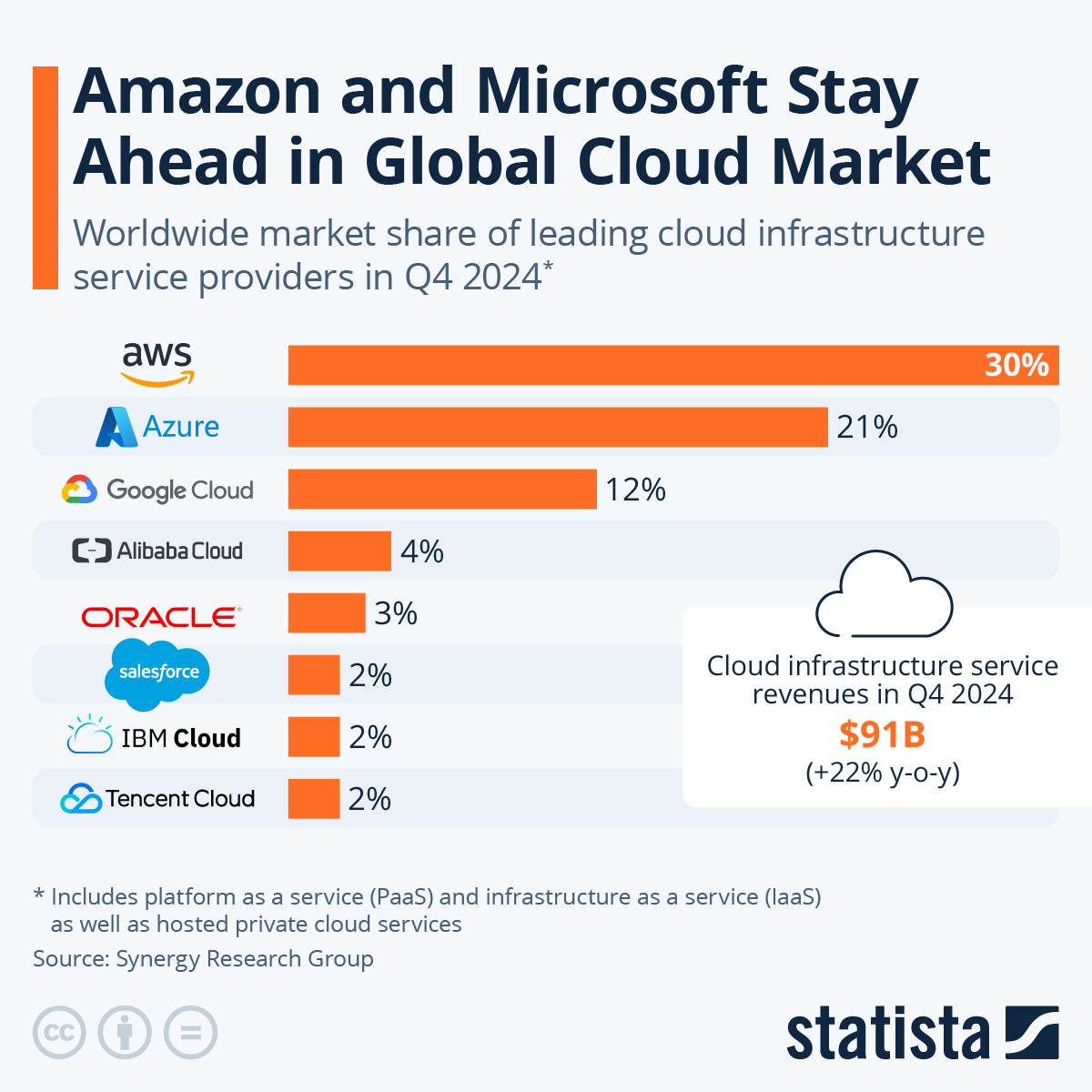
Image source: Statista.
The Undisputed Winner
Considering all factors, Alphabet, through its Google Cloud division, was the undeniable winner of the Q1 cloud face-off. Google Cloud not only achieved its fastest growth rate ever but also significantly outpaced its two larger cloud rivals.
Even Amazon's CEO, Andy Jassy, acknowledged the competitive landscape earlier this year, attempting to contextualize a smaller rival's rapid expansion. He noted, "It's very different having 24% year-over-year growth on a $142 billion annualized run rate than to have a higher percentage growth on a meaningfully smaller base, which is the case with our competitors."
While all three tech giants—Amazon, Microsoft, and Alphabet—present compelling investment opportunities, trading at approximately 30, 27, and 24 times forward earnings respectively, Alphabet stands out as particularly intriguing.
The company's Gemini AI is receiving widespread acclaim, and Google Cloud is experiencing phenomenal growth. Coupled with its staggering $460 billion cloud backlog, Alphabet clearly triumphed in the Q1 cloud battle, making its stock a highly compelling opportunity for investors right now.