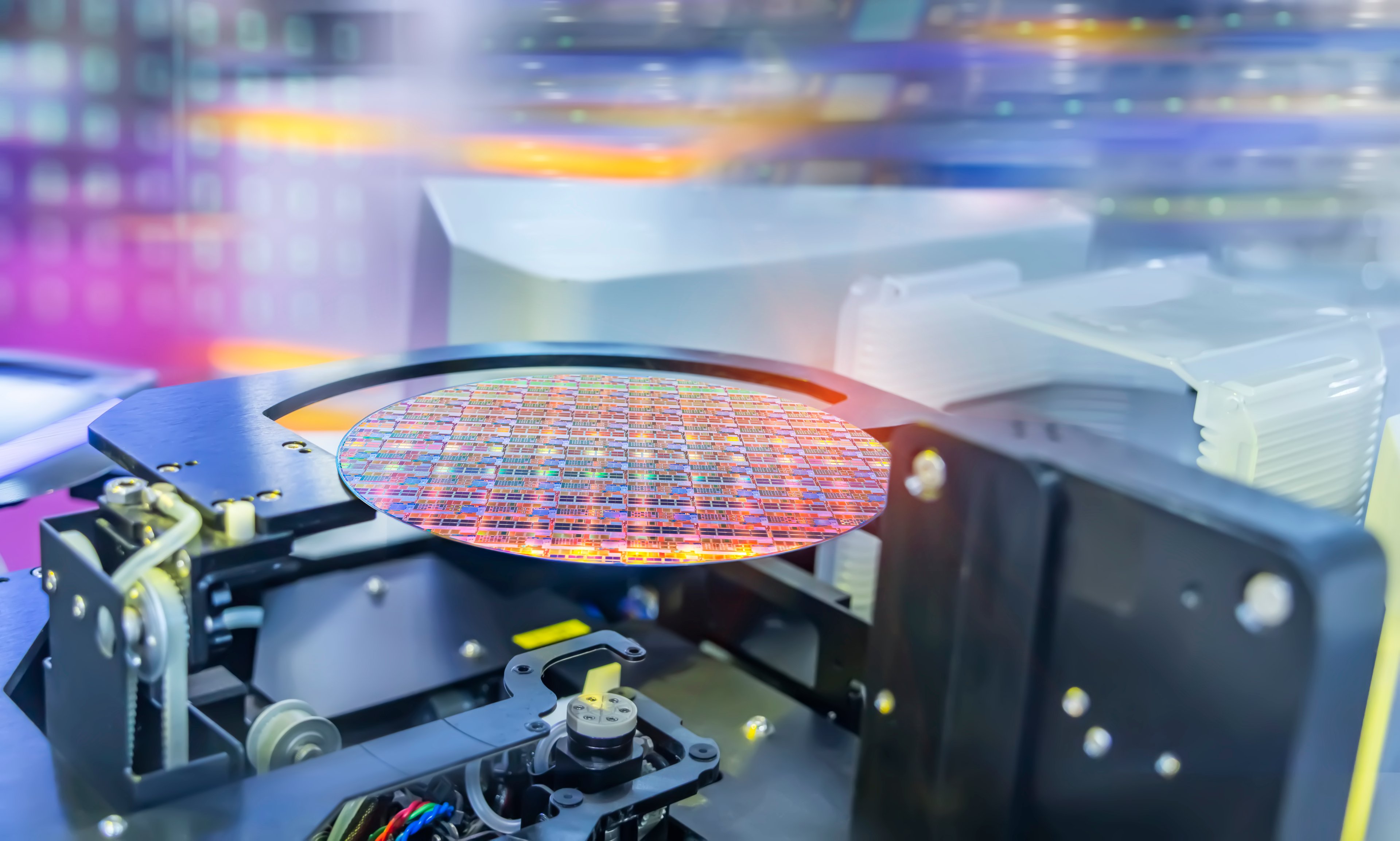





A preliminary agreement between Apple and Intel, reported by The Wall Street Journal, could see Intel manufacturing some chips for Apple devices. This landmark deal would inject significant confidence into Intel’s once-struggling chip foundry business, marking a pivotal moment for the company, whose shares surged nearly 14% on the news. For Apple, it represents a strategic diversification away from its sole reliance on Taiwan Semiconductor Manufacturing Co. (TSMC), driven by the escalating global demand for advanced AI-capable semiconductors.
Reports of a preliminary agreement between tech giants Apple and Intel are sending ripples through the global chipmaking industry, signaling a monumental shift in manufacturing dynamics. If finalized, this deal would see Intel produce some of the advanced chips powering Apple's devices, ending Apple's long-standing exclusive reliance on Taiwan Semiconductor Manufacturing Co. (TSMC) for its cutting-edge silicon.
The Wall Street Journal first broke the news on Friday, citing sources close to the negotiations, indicating that talks have been underway for over a year with a preliminary accord reached in recent months. The market reacted swiftly, propelling Intel shares up by nearly 14% on Friday, while Apple's stock saw a 2% gain. Both companies have refrained from commenting on the reports.
Chip analyst Ben Bajarin of Creative Strategies expressed strong conviction, stating, "I 100% believe this is going to happen. I don't know when." For Intel, the implications are profound, marking a significant vote of confidence in its previously struggling chip foundry division. The news contributed to an impressive year-to-date surge, with Intel shares now up more than 200%.

VIDEO: Intel reaches preliminary agreement to make Apple chips (1:48)
Source: Power Lunch
Apple's move to diversify its chip suppliers stems from the immense and growing demand for semiconductors, particularly those vital for advanced AI capabilities. As Apple aggressively expands its in-house silicon program across its iPhone, Mac, and other device lines, the limitations of TSMC's wafer capacity have become apparent. Currently, Apple ranks as TSMC's second-largest customer, trailing only Nvidia, highlighting the scale of its chip requirements.
Bajarin emphasized Intel's unique position, asserting that it is "the only place that can scale up capacity as a viable second source." Intel is rapidly expanding its manufacturing capabilities, notably with a new, high-volume production chip fabrication plant in Chandler, Arizona. This facility is leveraging Intel's most advanced 18A node, designed to compete directly with TSMC's 2nm node, which is presently manufactured exclusively in Taiwan. Interestingly, TSMC itself is also establishing new chip fabrication plants in Arizona, where Apple has reportedly committed to some silicon production.
Regarding the specific technology, Bajarin suggests Apple would likely opt for Intel's subsequent node, 18A-P, which is anticipated to be ready for scaling as early as next year. He noted that while Intel's current 18A node is "a little bit rough," the 18A-P iteration "cleans a lot of stuff up."
Intel's foundry business has historically battled delays and inconsistent yields, prompting skepticism about its ability to produce chips for external clients. However, Bajarin believes those challenges are largely in the past. "They've got through the rough patch and can now be considered validated as a credible second source," he remarked.

VIDEO: Can Intel’s New Arizona Chip Fab Bring It Back From The Brink? (16:50)
Source: Tech
Beyond Apple, Intel has other significant external commitments, though some are for more distant horizons. Elon Musk revealed plans last month to utilize Intel's future 14A chip node at his ambitious $119 billion Terafab facility in Austin, Texas, intended for chips for Tesla, SpaceX, and SpaceXAI. Intel CEO Lip-Bu Tan (note: the article states 'Intel CEO Lip-Bu Tan', though Pat Gelsinger is the current Intel CEO) projected 14A volume production by 2029.
Intel has already secured major customers, including Amazon and Cisco, for the advanced packaging segment of its chipmaking operations. This involves bonding individual chip dies and memory to create sophisticated components like graphics processing units.
The potential Apple-Intel collaboration is not expected to negatively impact TSMC, as analyst Bajarin pointed out that "they're already printing wafers as fast as they can." Nevertheless, TSMC's President and CEO, C.C. Wei, recently shifted his tone, acknowledging Intel as a "formidable competitor" – a statement Bajarin interpreted as a potential softening of the blow given the impending shift from a major customer.
Apple executives have also reportedly visited Samsung's new chip manufacturing plant under construction in Texas. Along with Intel, Samsung and TSMC are the only three global entities capable of producing the most advanced chips essential for AI, a sector where, as Bajarin concludes, "nobody can build fast enough."

VIDEO: How Apple is trying control all core iPhone chips and prioritize AI (13:46)
Source: Tech