





Amazon and Alphabet are making colossal investments in data center infrastructure, projecting a combined $420 billion in capital expenditures for 2026 to fuel their booming cloud computing and AI initiatives. Despite questions about the sheer scale of this spending, the accelerating revenue growth of Amazon Web Services (AWS) and Google Cloud, coupled with intense demand for computing capacity, suggests these significant outlays are a strategic necessity poised for substantial returns.
Amazon (AMZN -1.78%) and Alphabet (GOOG -2.09%, GOOGL -2.28%) stand out as the leading investors in the burgeoning data center arena. For 2026, Amazon's projected capital expenditures are approximately $220 billion. Alphabet isn't far behind, with guidance ranging from $195 billion to $205 billion, though this figure has been consistently raised quarter-over-quarter and could exceed the $200 billion midpoint. Essentially, both tech giants possess virtually unlimited resources to expand their computing capacity. However, this represents an enormous sum that could have been allocated differently.
Hypothetically, if Amazon and Alphabet had chosen to distribute this capital as a one-time dividend, Amazon shareholders could have received $20.41 per share, and Alphabet investors $16.40 per share—a substantial portion of their stock value. But would such a move have been a sound financial decision? Let's delve into the rationale behind their massive spending.

Image source: Getty Images.
Cloud Computing: A Rapidly Expanding Frontier
Both Amazon and Alphabet operate robust cloud computing divisions that necessitate substantial investments to keep pace with demand. At its heart, cloud computing functions as a rental service; when demand for capacity soars, new infrastructure must be brought online, a costly but ultimately profitable endeavor that yields returns many times over the initial outlay. This same principle underpins Amazon and Alphabet's expenditures on AI data centers, and current indicators suggest these investments are already paying dividends.
During the second quarter, Amazon Web Services (AWS), Amazon's premier cloud platform, reported an impressive 37% year-over-year revenue growth, marking its strongest performance in nearly five years. This momentum is far from peaking. Amazon CEO Andy Jassy highlighted in the company's conference call that existing computing capacity is insufficient to meet anticipated demand in 2026, a trend he expects to extend into 2027, with demand already being observed for 2028. This overwhelming interest in expanded computing capacity strongly validates Amazon's significant spending.
Alphabet's Google Cloud is experiencing even more explosive growth, with revenue surging 82% year-over-year. While Google Cloud is a smaller segment compared to AWS, generating $24.8 billion in Q2 against AWS's $42.2 billion, its smaller base enables a faster growth trajectory. Another catalyst for Google Cloud's expansion is the sale of its proprietary AI chips. These chips offer superior performance at a reduced cost compared to conventional graphics processing units (GPUs) for optimized workloads. Alphabet anticipates a significant increase in chip sales next year, further propelling Google Cloud's growth rate, potentially into triple digits, for the foreseeable future.
Amazon (AMZN), with a market cap of approximately $2.7 trillion and a gross margin of 50.77%, and Alphabet (GOOGL), boasting a market cap of around $4.0 trillion, a gross margin of 60.94%, and a dividend yield of 0.26%, are both demonstrating rapid growth that justifies their substantial infrastructure investments.
Valuation and Investment Outlook
Neither Amazon nor Alphabet can be considered "cheap" stocks, yet top-tier market leaders seldom trade at a discount. The key lies in evaluating their projected growth and whether the current price aligns with future potential. Using 2027 earnings projections, both companies appear reasonably valued. Amazon trades at a forward price-to-earnings (P/E) ratio of 25, while Alphabet trades at a forward P/E of 23 at the time of this analysis.
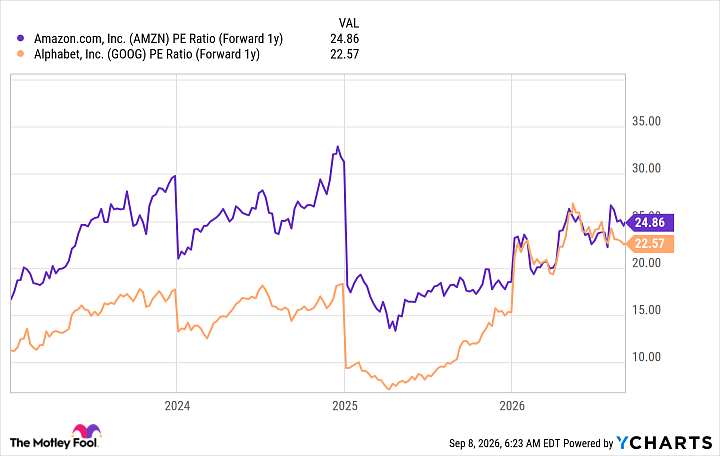
AMZN PE Ratio (Forward 1y) data by YCharts.
This valuation implies that roughly one year's worth of growth is already factored into each stock's price, which is reasonable given their rapid expansion. While they might not be the absolute top performers in the market's future, their potential for outperformance remains strong, making them compelling stock picks today.














