




Legendary investor Stanley Druckenmiller has made significant portfolio adjustments in Q1 2026, completely divesting his substantial stake in Alphabet (Google) after its impressive run. He has instead placed new, strategic bets on the burgeoning field of agentic artificial intelligence, acquiring positions in Intel (INTC) and Arm Holdings (ARM). These moves highlight a shift towards companies foundational to the next wave of AI development, focusing on CPU technologies crucial for autonomous AI tasks.
When it comes to market foresight, few investors rival the acumen of Stanley Druckenmiller. The now-billionaire, who founded Duquesne Capital in 1981, achieved an astonishing average annual return of over 30% for three decades without a single losing year before closing his fund in 2010. Today, he masterfully manages his family's wealth through the Duquesne Family Office, and his quarterly moves are eagerly watched by retail investors seeking cues from a true market titan.
In the first quarter of 2026, Druckenmiller executed several significant portfolio adjustments. Notably, he completely liquidated his stake in Alphabet (Google's parent company), which was valued at over $120 million at the close of 2025. Simultaneously, he initiated new positions in two companies that represent direct, strategic investments in the rapidly evolving field of agentic artificial intelligence (AI).

Image source: Getty Images.
Cashing Out of Alphabet After a Stellar Run
Druckenmiller decided to lock in profits from his Alphabet position, following a period of exceptional performance for the tech giant. This move likely stems from valuation considerations, as Alphabet's forward earnings multiple surged from under 15x in early 2025 to approximately 27x currently. Once considered a value play among the "Magnificent Seven," Alphabet has successfully navigated numerous challenges.
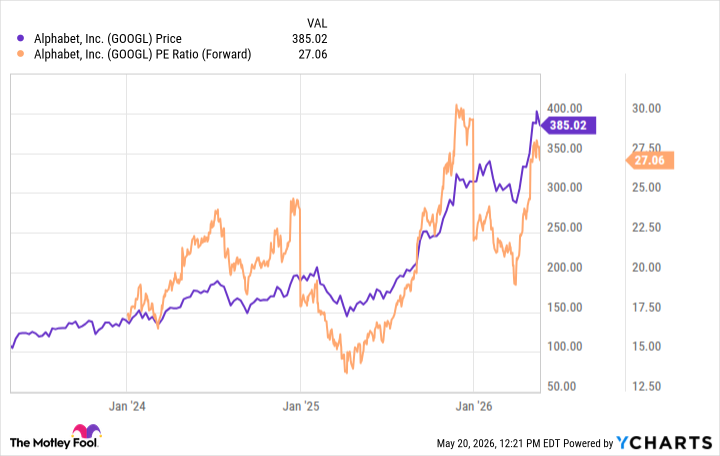
GOOGL data by YCharts
Despite facing an antitrust lawsuit from the U.S. Department of Justice regarding its digital advertising and search practices – a case where a federal judge largely sided with the prosecution – Alphabet avoided a forced divestiture of its popular Chrome web browser. Furthermore, the company showcased the competitive prowess of its Gemini large language models (LLMs), reassuring investors about its capacity to sustain dominance in traditional digital search.
While long-term questions persist about AI's ultimate impact on search, Alphabet boasts a diversified portfolio of robust and expanding businesses. These include its burgeoning cloud infrastructure segment, poised to benefit significantly from global AI adoption, its powerful YouTube video platform, its autonomous driving division Waymo, and its proprietary AI semiconductor operations. Though Druckenmiller and other major funds are taking gains, many retail investors may still find Alphabet an attractive long-term hold.
Pivoting to Agentic AI: The Intel and Arm Play
In Q1, Druckenmiller's Duquesne Family Office initiated new positions in two companies poised to capitalize directly on agentic AI. The fund acquired over 411,000 shares of Intel (INTC) and 106,700 shares of Arm Holdings (ARM). At the quarter's end, these stakes were valued at approximately $18 million and $16 million, respectively.
Both investments underscore a belief in agentic AI, as Intel and Arm are stalwarts in the central processing unit (CPU) market. While graphics processing units (GPUs) initially garnered significant attention for their role in training large language models due to their parallel processing capabilities, the rise of agentic AI is bringing CPUs back into the spotlight. Agentic AI involves AI systems autonomously performing complex tasks based on minimal initial instructions, and CPUs are exceptionally well-suited for the task orchestration, external communication, memory management, and data processing required by these agents.
Intel CEO Lip-Bu Tan highlighted this shift during the company's Q1 earnings report, stating, "On the inference side, in terms of orchestration, control plane, and also managing all the different agents with data, CPU is much more efficient. The ratio of CPU to GPUs [in data centers] used to be 1-to-8, and now it is 1-to-4, and I think it could move toward parity or even better. So I think that demand is very strong."
Intel presents an intriguing investment opportunity not only as a seller of CPUs for data centers but also due to its foundry business, which manufactures and packages both CPUs and GPUs. Arm Holdings, on the other hand, provides a different avenue for CPU exposure. Arm primarily licenses its intellectual property for CPU designs to industry giants like Nvidia, Apple, Microsoft, OpenAI, and Alphabet. However, sensing robust demand, Arm has recently ventured into designing and selling its own CPUs, projecting this new business segment could generate $15 billion in annual revenue within the next five years.
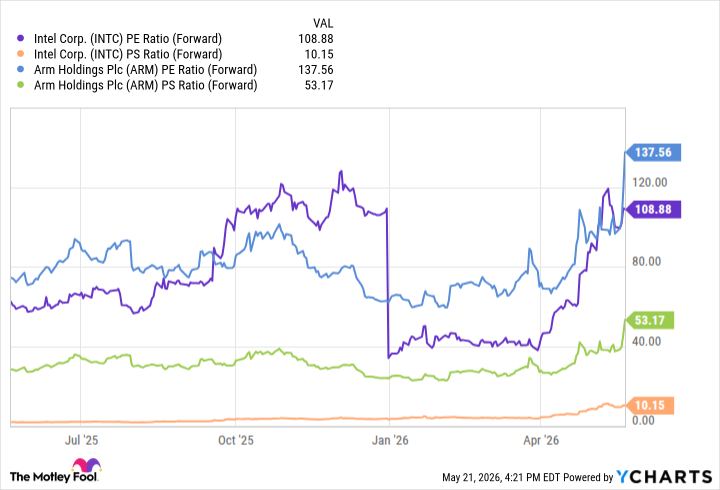
INTC PE Ratio (Forward) data by YCharts.
Should the adoption of agentic AI continue its rapid ascent, both Arm and Intel stand to benefit significantly. However, potential investors should acknowledge that these stocks are not currently trading at a discount. Therefore, it's prudent to size positions thoughtfully, perhaps starting with smaller investments and employing dollar-cost averaging to build larger stakes over time.