


Advanced Micro Devices (AMD) reported stellar first-quarter results, surpassing analyst expectations for both earnings and revenue, driven by explosive growth in its data center segment. The company also issued an optimistic revenue forecast for the second quarter, fueling a significant surge in its stock. CEO Lisa Su emphasized the data center’s role as the primary growth driver, with strong confidence in future AI revenue, as AMD expands its offerings with systems like Helios and secures partnerships with major clients like OpenAI and Meta.
Advanced Micro Devices (AMD) sent shockwaves through the market, with its stock leaping approximately 15% in extended trading after reporting first-quarter earnings that not only surpassed Wall Street's expectations but also delivered an optimistic revenue forecast for the upcoming quarter. The semiconductor giant's impressive performance is largely attributed to the insatiable demand for chips powering artificial intelligence (AI) workloads, solidifying its position in the rapidly expanding AI ecosystem.
For the quarter ended in March, AMD showcased strong financial health:
- Adjusted EPS: $1.37, significantly beating the LSEG consensus estimate of $1.29.
- Revenue: $10.25 billion, surpassing the expected $9.89 billion.
This marked a substantial 38% year-over-year revenue increase from $7.44 billion a year ago. The data center segment emerged as the undeniable growth engine, with sales soaring 57% to $5.8 billion, up from $3.67 billion in the same period last year. Net income also saw a robust climb to $1.38 billion, or 84 cents per share, compared to $709 million, or 44 cents per share, in the prior year.
Looking ahead, AMD projects approximately $11.2 billion in revenue for the second quarter, comfortably exceeding LSEG's analyst expectations of $10.52 billion.
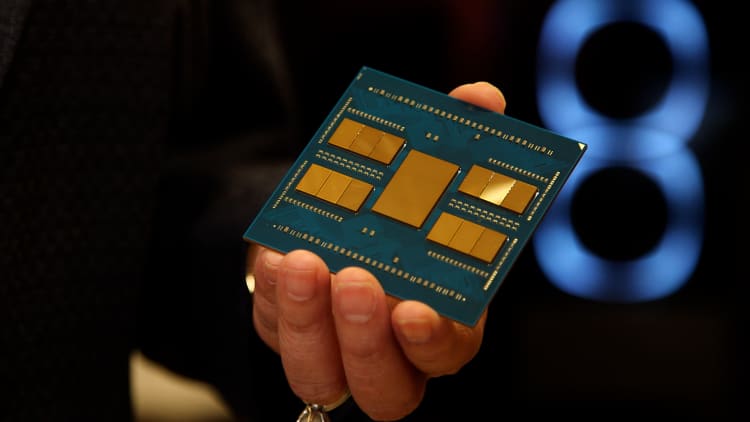
AMD CEO Lisa Su highlighted the pivotal role of the data center unit in the company's success. "The data center unit is now the primary driver of our revenue and earnings growth," Su stated, expressing strong confidence in AMD's ability to achieve tens of billions of dollars in data center AI revenue next year and surpass its long-term growth target of over 80% in the coming years.
AMD's stock has been a standout performer, more than tripling over the past year, with a 66% surge in 2026 alone. While rival Nvidia maintains a leading position in the AI GPU market, investors are increasingly bullish on AMD, recognizing the vast opportunities for multiple players in the burgeoning AI space.
Beyond GPUs, AMD is a long-standing leader in central processing units (CPUs), which are experiencing a significant resurgence as agentic AI workloads drive evolving compute needs. This was further bolstered by a recent collaboration with Intel, where both companies announced a new instruction set for x86 CPUs called AI Compute Extensions, designed to dramatically boost performance and energy efficiency.
The broader chip industry continues to navigate a complex landscape marked by a global memory shortage, intense AI demand, and manufacturing/packaging capacity constraints exacerbated by supply chain disruptions, including those from the war in Iran.
This "frenzy" has benefited several semiconductor-related companies. Intel recently celebrated its best month ever in April, following strong first-quarter results. Memory maker Micron has seen its shares skyrocket over 700% in the past year, pushing its market capitalization past $700 billion.
AMD is also expanding its offerings with the upcoming Helios, its first full rack-scale system for AI data centers, expected to ship later this year. Helios is positioned as a direct competitor to Nvidia's high-end Grace Blackwell and Vera Rubin systems, which can fetch upwards of $3 million.
Major AI infrastructure builders, including OpenAI and Meta, have already committed to shipments of Helios, signaling AMD's emergence as a crucial alternative for hyperscalers seeking to secure sufficient compute power. Meta's multiyear deal, announced in February, includes the deployment of up to 6 gigawatts of AMD GPUs and AI-optimized CPUs for its data centers. Shipments are slated to begin in the second half of the year, with Lisa Su emphasizing deep co-engineering relationships and multi-year visibility into large-scale deployments with these key partners.