



Alphabet reported a mixed Q2 2026, beating revenue estimates with stellar cloud growth, but missed on the bottom line. The stock dipped as investors worried over surging capital expenditures for AI infrastructure. Despite the company’s aggressive push into AI with projects like Gemini 4, the article advises investors against overly ambitious moves with GOOGL stock, suggesting a more favorable entry point near $300 amidst the post-earnings correction.
/Alphabet%20(Google)%20Image%20by%20Markus%20Mainka%20via%20Shutterstock.jpg "Alphabet’s AI Ambitions Surge, But GOOGL Investors Should Exercise Caution Post-Q2 Earnings")
Tech giant Alphabet (GOOG) (GOOGL) unveiled its Q2 2026 earnings results on July 22, post-market close. The report presented a mixed financial picture; while the company surpassed revenue expectations, it fell short on the bottom line. Subsequently, the stock experienced a downturn, reflecting investor concern over the escalating capital expenditure dedicated to advancing its artificial intelligence (AI) infrastructure. This follows my earlier analysis, where I highlighted that despite GOOGL shares dipping below Berkshire Hathaway’s (BRK.A) (BRK.B) June private placement acquisition price, it wasn't yet a definitive "screaming buy." We now delve deeper into Alphabet’s forward-looking prospects to assess if GOOGL stock currently represents a compelling investment opportunity.
Alphabet's Q2 Financial Performance at a Glance
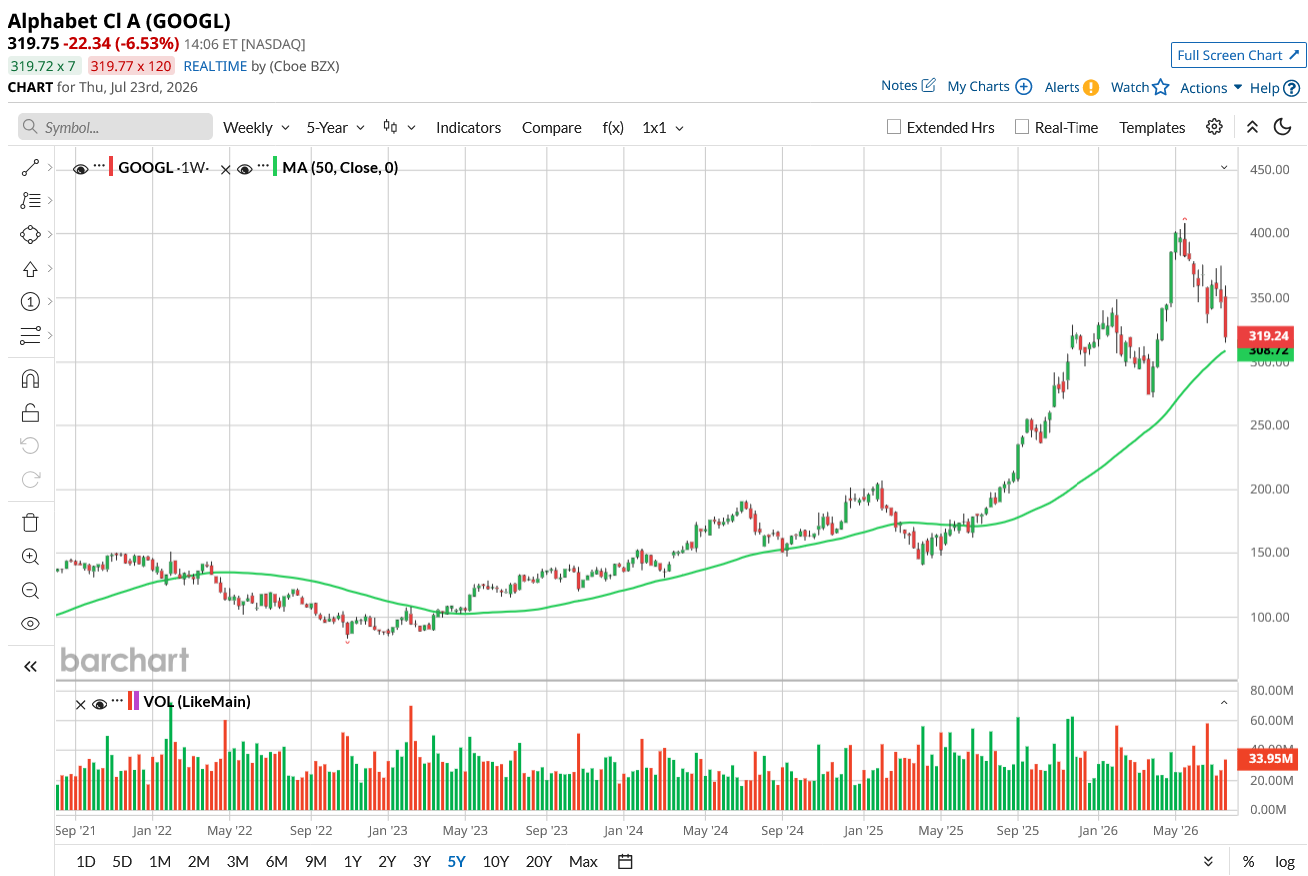
Examining the core figures from Alphabet’s latest quarterly update, revenues soared 24% year-over-year (YoY) to reach an impressive $119.8 billion, comfortably exceeding the analyst consensus of $116.9 billion. While Google Search revenues saw a respectable 17% YoY increase, slightly under analyst projections, YouTube's advertising segment outperformed expectations with a 13% rise. The standout performer, however, was Alphabet Cloud, which delivered an extraordinary 82% growth—significantly surpassing the 63% growth anticipated by analysts and echoing its strong performance in the prior quarter.
Notably, Alphabet’s cloud division continues to outpace its major competitors, Amazon (AMZN) and Microsoft (MSFT), in terms of revenue growth. The company also revealed a substantial increase in its cloud order backlog, including significant chip orders, which expanded by over $50 billion from Q1 to exceed a staggering $500 billion.
However, these robust cloud revenue figures were somewhat tempered by two critical points. Alphabet indicated an expectation of near-term margin compression, attributed to its reliance on third-party compute capacity to bridge the current demand-supply gap. Furthermore, the company revised its 2026 capital expenditure (capex) forecast upward by $15 billion, setting a new range of $195 billion to $205 billion, a significant increase from prior guidance.
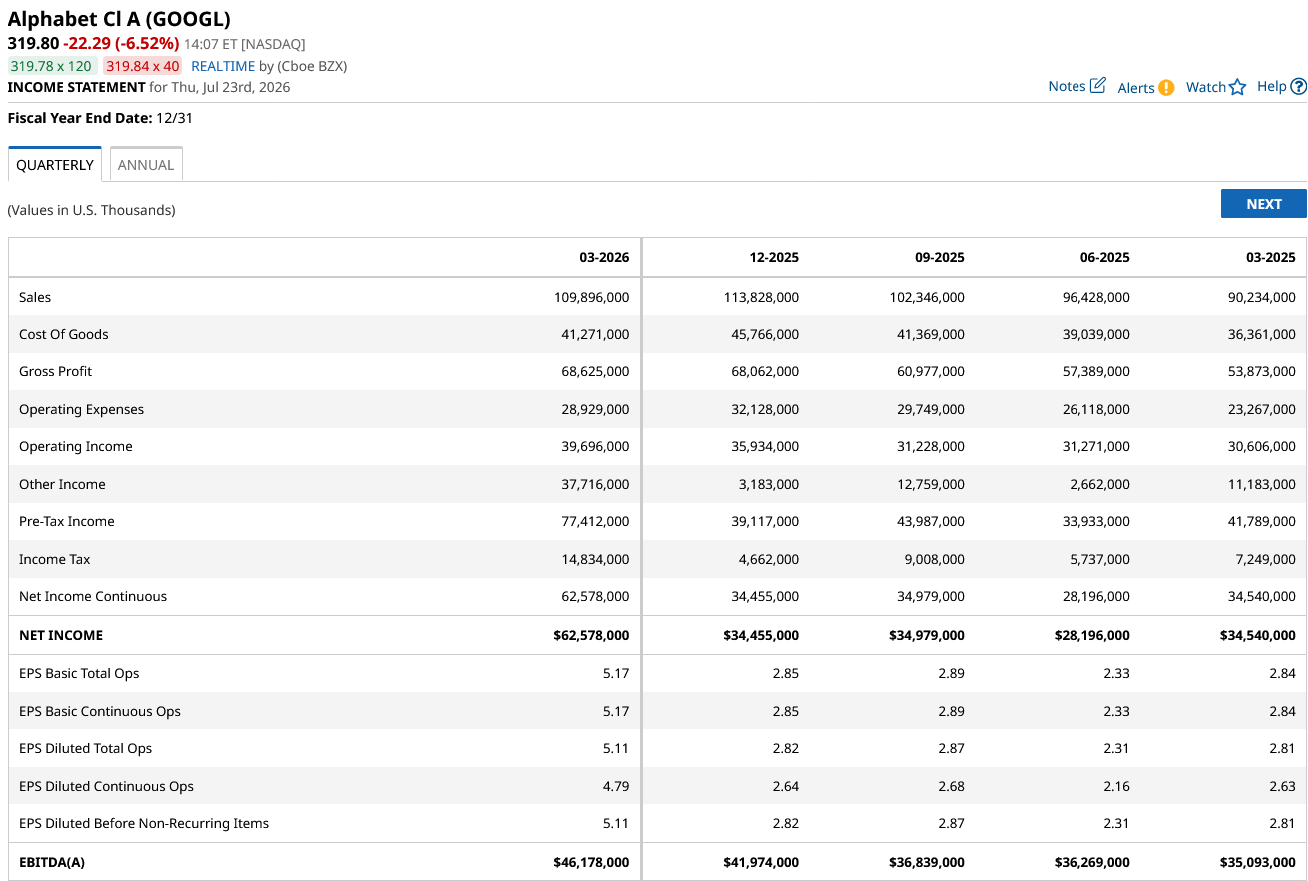
Interestingly, while investors had previously shrugged off a similar capex increase announced during the Q1 earnings call, propelling the stock up by nearly 10%, their reaction this quarter has been markedly different. Despite the monumental growth in cloud revenues, shares are now trading down by a comparable percentage, signaling a less forgiving market sentiment.
Alphabet's Bold AI Ambitions Drive Increased Spending
Alphabet is demonstrably escalating its investment in AI infrastructure. While specifics for the 2027 budget were not fully disclosed by management, the prevailing sentiment from the Q2 earnings call strongly implies that next year's budget will likely surpass even this year's elevated figures.
A key focus of this ambition is Gemini 4, which CEO Sundar Pichai characterized as "ambitious" no less than three times during the conference call. Pichai articulated, "We wanted to compete at the frontier level of where the frontier will be when Gemini 4 comes out. And so, we are applying a lot of our compute and effort in that direction," underscoring the company’s commitment to leading in advanced AI development.
Exercise Prudence with GOOGL Stock for Now
Alphabet has undeniably solidified its position as a key player in the AI landscape, effectively quelling concerns that it might cede its dominance in search to emerging AI competitors. The company boasts multiple avenues for growth, including its specialized tensor processing units (TPUs), which are poised to sustain robust top-line expansion in the foreseeable future. In Q2, Alphabet initiated the delivery of TPUs to customer data centers. While specific TPU backlog figures are not separate from the broader cloud backlog, the company anticipates recognizing the "vast majority" of revenues from these current agreements in the coming year.
The recent pullback in GOOGL stock from its 2026 peak has naturally led to a valuation correction, with shares now trading at a forward price-to-earnings (P/E) multiple of 24.5x. From an investment perspective, I anticipate the near-term risk-reward profile for GOOGL to become significantly more attractive should the stock approach the $300 mark amidst the current post-earnings sell-off, signaling an opportune moment for aggressive accumulation.
On the date of publication, Mohit Oberoi held positions in: GOOG, AMZN, and MSFT. This content is provided for informational purposes only. For full disclosure details, refer to the Barchart Disclosure Policy here.