

Billionaire investor Stanley Druckenmiller has sold his stake in Broadcom (AVGO) and purchased shares in Alphabet (GOOGL). This strategic shift indicates a preference for companies building integrated AI platforms over component suppliers.
The move aligns with Berkshire Hathaway’s massive $17 billion investment in Alphabet, signaling confidence in the tech giant’s long-term AI strategy despite current capital expenditure pressures. Druckenmiller’s decision highlights a bet on Alphabet’s complete AI ecosystem, from chip design to end-user services.
In a significant portfolio shift revealed by recent 13F filings, billionaire investor Stanley Druckenmiller's Duquesne Family Office has fully divested its stake in Broadcom (AVGO) while simultaneously initiating a new position in Alphabet (GOOGL). This strategic move highlights a nuanced perspective on the artificial intelligence (AI) infrastructure landscape, suggesting a preference for companies building integrated AI platforms over component suppliers.
Alphabet's reliance on Broadcom for designing its custom Tensor Processing Units (TPUs) – the specialized chips powering its AI infrastructure – makes Druckenmiller's decision particularly noteworthy. By favoring Alphabet, the company that utilizes these advanced chips and integrates them into its end-user services, Druckenmiller appears to be betting on the downstream platforms rather than the upstream hardware providers.
Image source: The Motley Fool.
Why Druckenmiller Might Be Selling Broadcom
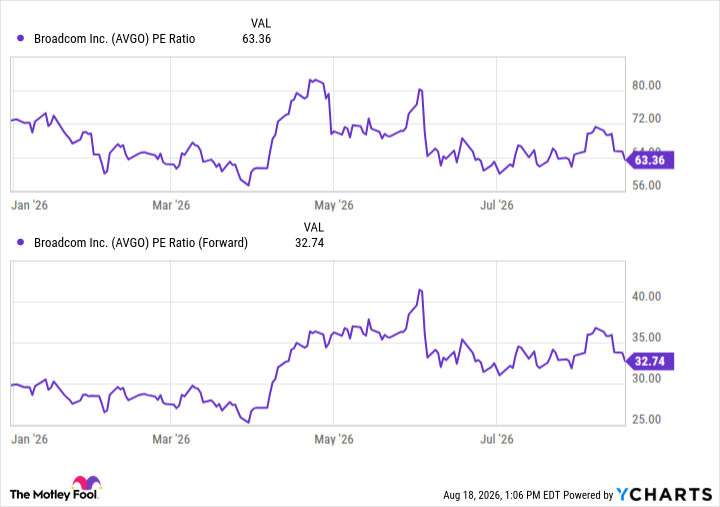
The rationale behind Druckenmiller's exit from Broadcom likely stems from valuation concerns and the evolving dynamics of the AI semiconductor market. Despite recent valuation adjustments, Broadcom's price-to-earnings (P/E) and forward P/E ratios remain elevated compared to the broader semiconductor industry. This suggests that the market may have already priced in significant near-term gains from hyperscaler contracts.
AVGO PE Ratio data by YCharts
Furthermore, Broadcom's position as a supplier makes it susceptible to the spending decisions of large tech companies. Druckenmiller's move may indicate a belief that the most substantial gains from the foundational AI infrastructure layer have already been realized, and future returns may be harder to come by. Additionally, holding both the supplier (Broadcom) and the customer (Alphabet) of the same chips could introduce unnecessary correlation risk in a decelerating AI spending environment.
The Bull Case for Alphabet
Alphabet presents a compelling investment case due to its extensive data assets from Google Search and YouTube, its leading AI research capabilities (including DeepMind), and its proprietary hardware stack. The company's TPUs are not just cost-saving measures; they are deeply integrated into Alphabet's software and services, driving AI-driven revenue.
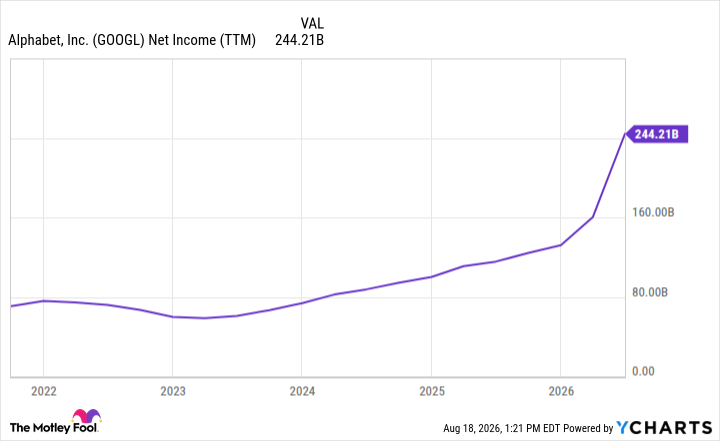
By owning the entire AI value chain – from chip design and deployment to software and consumer products – investors gain exposure to a powerful, self-reinforcing ecosystem that is difficult for competitors to replicate. Alphabet's recent acceleration in Google Cloud growth demonstrates that its capital expenditures are translating into high-margin revenue and expanding operating profits.

NASDAQ: GOOGL
Key Data Points
GOOGL Net Income (TTM) data by YCharts
Berkshire Hathaway's Massive Bet on Alphabet
Druckenmiller's conviction in Alphabet is echoed by Warren Buffett's Berkshire Hathaway, which poured an staggering $17 billion into the tech giant during the second quarter. This substantial investment suggests Berkshire views Alphabet not merely as a tech stock, but as a durable, long-term franchise. Even with Alphabet's recent increased capital expenditures impacting free cash flow, Berkshire's commitment underscores the long-term potential of its AI-driven services.
Ultimately, Druckenmiller's strategic rotation signifies a preference for companies that own the complete AI stack. This move reflects a willingness to tolerate short-term financial pressures for long-term technological leadership, positioning Alphabet as a key player in the future of artificial intelligence.





 "Robotaxi Revolution: Driverless Car Companies Amass Industrial Real Estate Ahead of Legalization")