



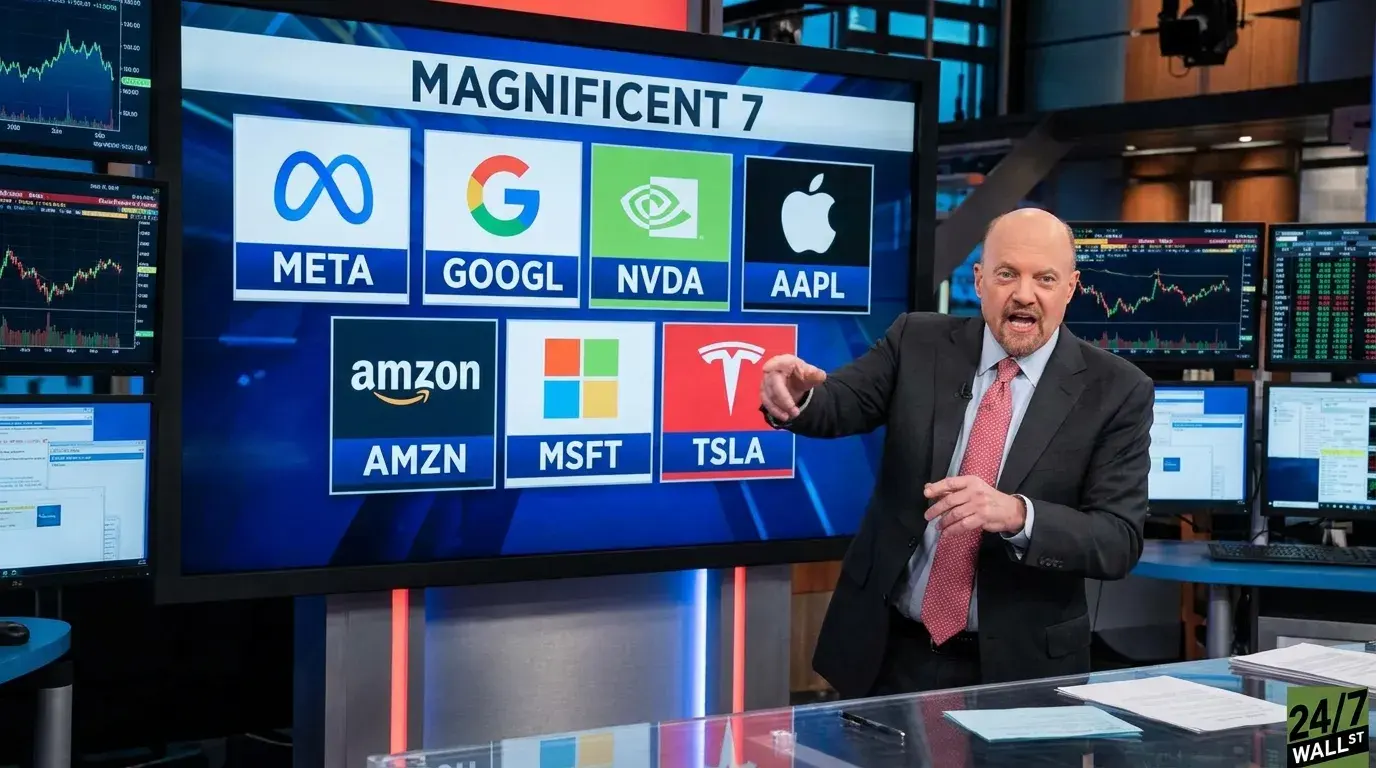
Jim Cramer, on Mad Money, urged investors to stop treating the ‘Magnificent Seven’ stocks as a single basket, emphasizing their unique business models, growth curves, margin profiles, valuations, and AI strategies. He highlighted how individual stocks like Meta can surge independently, even as others face headwinds. Cramer’s analysis underscores that the vast differences in financial metrics and future catalysts among these tech giants mean a blanket investment approach is a costly mistake.
On a recent episode of Mad Money, financial pundit Jim Cramer issued a stark warning to investors: stop treating the so-called 'Magnificent Seven' stocks as a singular entity. Cramer, whose charitable trust holds positions in six of the seven (excluding Tesla), argued passionately that each of these market titans boasts a unique investment thesis, growth trajectory, and risk profile. To indiscriminately 'dump' the entire group when one stock falters, he contends, is to leave significant money on the table.
The market's performance on July 10 underscored his point. While the broader S&P 500 gained a modest 0.43%, Meta Platforms (NASDAQ:META) surged by 5.97% to close at $669.21. This divergence highlights Meta's independent reaction to its capital spending narrative, distinct from the catalysts driving its peers.
The Five Distinctions That Define the 'Seven'
Cramer's analytical framework identifies five critical axes along which these companies diverge: distinct business models, varied growth curves, vastly different margin profiles, significant valuation gaps, and unique AI integration strategies.
Meta: The Ad Juggernaut Fueling an AI Vision
Meta is fundamentally an advertising powerhouse, leveraging its immense data moat to finance an ambitious AI moonshot. The company reported a robust Q1 revenue of $56.31 billion, a 33.08% year-over-year increase, with EPS hitting $10.44 (partially aided by a tax benefit but still comfortably above consensus). Management's decision to raise 2026 capex guidance to an astonishing $125 billion to $145 billion, as detailed in its Q1 8-K filing, underscores its commitment to AI infrastructure. With 3.56 billion daily users, Meta's spending story operates on a scale few rivals can match, making its stock highly sensitive to infrastructure-related headlines.
Alphabet: Search, Cloud, and Gemini's Pervasive Reach
Alphabet (NASDAQ:GOOGL) delivered Q1 revenue of $109.90 billion, up 21.8%. A standout performer was Google Cloud, which soared by 63% to $20.03 billion, boasting a backlog exceeding $460 billion. Prediction markets give a 92% probability that Alphabet will surpass its next quarterly EPS consensus. The stock has seen impressive gains, up 14.26% year-to-date and 101.67% over the past year. Gemini's deep integration across Android, Workspace, Cloud, and its partner ecosystem offers Alphabet a distinct AI trajectory, differing significantly from Meta's advertising-first approach.
NVIDIA: The Indispensable AI Infrastructure Supplier
NVIDIA (NASDAQ:NVDA) occupies a pivotal position, forming the bedrock of nearly every major hyperscaler's capital expenditure plans. Its Q1 fiscal 2027 revenue reached an astounding $81.6 billion, an 85% increase, with Data Center revenue specifically hitting $75.2 billion and Data Center networking rocketing by 199%. The company maintained a robust non-GAAP gross margin of 75.0%. CEO Jensen Huang aptly described the current AI factory buildout as "the largest infrastructure expansion in human history," and NVIDIA remains the most direct beneficiary of this monumental growth. A trailing P/E ratio near 32 appears modest when juxtaposed with its remarkable 85% revenue growth.
Apple: A Blend of Hardware Cycles and Services Annuity
Apple (NASDAQ:AAPL) announced a record March quarter with $111.18 billion in revenue, up 16.6%. iPhone sales contributed $56.99 billion, while Services achieved an all-time high of $30.98 billion. The company's board approved an additional $100 billion share buyback, underscoring its unparalleled cash-generation capabilities. A trailing P/E ratio near 38 suggests the market values Apple for its vast installed base, its lucrative Services ecosystem, and its consistent capital-return program, rather than a pure AI infrastructure play.
Amazon: Retail Powerhouse, AWS Dominance, and Custom Silicon Prowess
Amazon (NASDAQ:AMZN) posted Q1 revenue of $181.52 billion, up 17%, with an EPS of $2.78, boosted by gains from Anthropic-related investments but still exceeding consensus. Amazon Web Services (AWS) continued its strong growth, expanding by 28% to $37.59 billion with an impressive operating margin of 37.7%. CEO Andy Jassy revealed that Amazon's custom chips business, encompassing Graviton, Trainium, and Nitro, has surpassed a $20 billion annual revenue run rate. Prediction markets assign a 98.5% probability that Amazon's 2026 capital expenditure will exceed $170 billion.
Microsoft: Enterprise AI with Copilot and Azure's Expanding Backlog
Microsoft (NASDAQ:MSFT) reported Q3 revenue of $82.89 billion. Azure and other cloud services revenue climbed by 40%, while its burgeoning AI business achieved a $37 billion annual run rate, growing an astounding 123%. Despite these strong figures, the stock is down 20.3% year-to-date, making it a notable outlier within the group and a live testament to Cramer’s argument that these individual names can indeed decouple.
Tesla: The Distinctive Outlier
Tesla (NASDAQ:TSLA) is Cramer's deliberate exclusion from the 'Magnificent Six'. With a trailing P/E of 371, a modest 3.95% profit margin, and a 9.33% year-to-date decline, Tesla's business model is largely predicated on the future optionality of robotaxi services and the Optimus humanoid robot. This speculative thesis stands in stark contrast to the robust ad and cloud cash flows that underpin the other six companies.
The overarching message is clear: companies exhibiting growth rates spanning from approximately 15% to 85%, sporting profit margins from a mere 4% to a staggering 66%, and trading at trailing P/E multiples ranging from 24 to 371 simply cannot be treated as a homogenous group. The 'Mag 7' label, while a convenient shorthand, risks obscuring the fundamental differences that truly matter. Investors who take the time to evaluate each thesis independently stand a much better chance of identifying and holding onto winners, even when individual members of this celebrated group experience turbulence.