




The battle for the best AI stock pits tech giant Alphabet against memory chip specialist Micron Technology. While Alphabet offers a robust, diversified long-term AI strategy with consistent growth across its cloud and generative AI platforms, Micron is demonstrating astonishing short-term revenue surges from booming data center demand. Investors face a choice between Alphabet’s stable, enduring AI integration and Micron’s explosive, yet potentially more cyclical, infrastructure play.
In the rapidly evolving artificial intelligence (AI) investment landscape, discerning investors often weigh two distinct strategies: backing established tech giants or investing in essential infrastructure providers. This article pits Alphabet (NASDAQ: GOOG, GOOGL), a diversified AI innovator, against Micron Technology (NASDAQ: MU), a crucial memory chip supplier. Both have delivered strong returns over the past year, but which presents the more compelling opportunity moving forward?
While both companies have proven profitable investments, their trajectories and inherent risks differ significantly, making the choice for a 'better' stock highly dependent on an investor's time horizon and risk tolerance.

Image source: Getty Images.
Alphabet's Enduring AI Dominance
Alphabet's comprehensive AI strategy positions it for sustainable, long-term gains. The company is embedding AI across its vast product ecosystem, from its Gemini generative AI platform integrated into Google Search to its burgeoning cloud computing division. Google Cloud reported an impressive 63% revenue growth in the first quarter, underscoring the strong demand for its AI-powered services. This widespread integration and robust growth across multiple business units suggest a resilient and prolonged period of AI-driven expansion for Alphabet.
As of recent data, Alphabet's Class A shares (GOOGL) trade at approximately $360.36, experiencing a slight dip of 0.23% (-$0.85) today. With a substantial market cap of $4.4 trillion, a forward price-to-earnings ratio of 24, and a gross margin of 60.43%, Alphabet represents a stable, albeit rapidly growing, large-cap tech investment. Its 52-week range spans $172.77 to $408.61, indicating a healthy appreciation over the last year. Alphabet's broad and diversified approach to AI ensures its gains will likely be longer-lived.
Micron's Explosive Short-Term Performance
Micron Technology, on the other hand, is currently experiencing a phenomenal surge driven by the insatiable demand for memory chips essential for data centers and AI infrastructure. Its latest quarter saw revenue skyrocket by an astonishing 346% year over year, reaching $41.5 billion and significantly surpassing its own guidance. The company projects even further growth, anticipating $50 billion in revenue for the next quarter. Micron's management also foresees sustained memory chip demand and supply constraints extending beyond 2027.
However, the key question for Micron's long-term prospects revolves around the eventual plateau of the current data center build-out cycle. While some residual demand will persist, it's uncertain if the current peak demand will ever be replicated. This potential cyclicality presents a unique risk for Micron investors looking beyond the immediate boom.
Currently, Micron Technology (MU) trades around $973.59, seeing a 5.68% decline today (-$58.69). Despite this daily fluctuation, its recent performance has been remarkable. Micron boasts a market capitalization of $1.1 trillion and an impressive gross margin of 72.60%. Its 52-week range highlights extreme volatility and growth, from $103.38 to $1255.00. While its growth is jaw-dropping, the long-term sustainability of this pace remains a subject of debate among investors.
A Difficult Valuation Comparison
Directly comparing the valuations of Alphabet and Micron is challenging due to their disparate growth rates, differing long-term outlooks, and distinct fiscal calendars. Alphabet, with its more predictable growth trajectory and a forward price-to-earnings (P/E) ratio of 24, is a more conventional stock to analyze. Its fiscal year aligns with the calendar year, making projections straightforward.
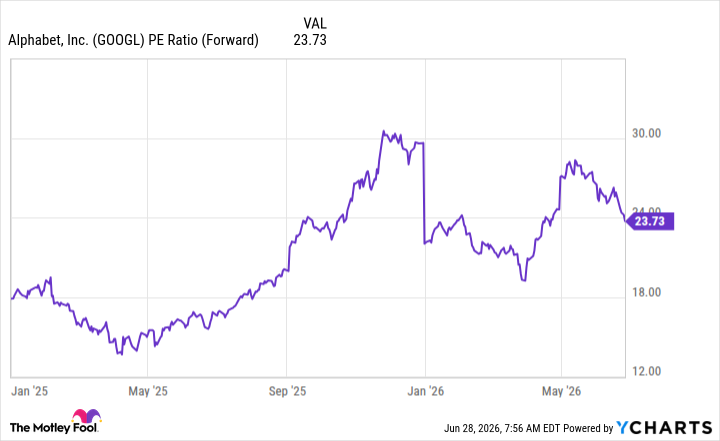
GOOGL PE Ratio (Forward) data by YCharts.
Micron, with its fiscal year ending in August, requires a different approach. Even after its significant rally this year, the stock appears cheap based on fiscal 2026/2027 earnings projections. However, the core challenge lies in valuing a company whose primary business strength could diminish in a few years if data center demand stabilizes or memory chip production outstrips demand. Despite these uncertainties, Micron's explosive earnings growth and low projected valuation make it a difficult stock to ignore for those comfortable with higher risk.
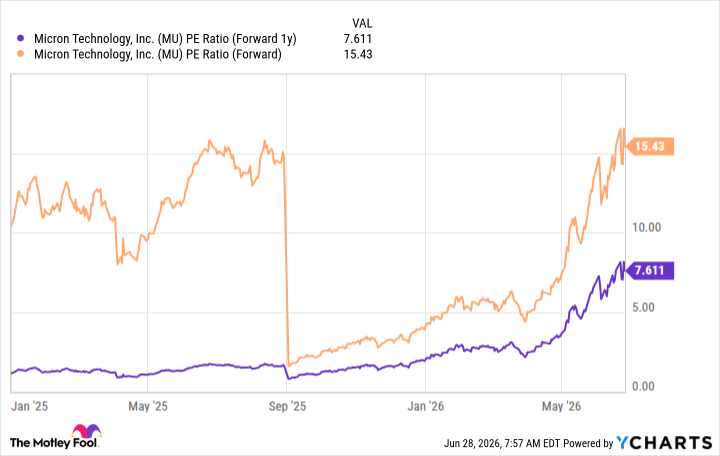
MU PE Ratio (Forward 1y) data by YCharts.
The Verdict: A Choice for Different Investors
Ultimately, the choice between Alphabet and Micron depends on your investment philosophy. For investors seeking an investment with less potential for outsized gains but also reduced volatility and a robust, diversified long-term growth story, Alphabet remains the stronger AI stock pick. Its broad AI integration, thriving cloud business, and consistent growth make it a cornerstone for any AI-focused portfolio.
Conversely, for those willing to closely monitor their investments and accept higher execution risks beyond 2027, Micron offers the potential for significant short-term appreciation. Its current explosive growth and attractive projected valuation are hard to overlook for aggressive investors.














