



SpaceX has inked a massive deal with Google, agreeing to lease 110,000 Nvidia GPUs, signifying a major expansion for SpaceX and a testament to Nvidia’s continued dominance in the AI chip market.
Despite Google’s investments in custom AI hardware like TPUs, the company is turning to Nvidia’s GPUs, highlighting the unmatched flexibility and ecosystem Nvidia provides, which ASICs have yet to fully replace.
In a move that has significant implications for the semiconductor industry, SpaceX has announced a substantial compute capacity agreement with Alphabet's Google. This deal, revealed on June 5th, involves SpaceX leasing a massive cluster of 110,000 Nvidia GPUs, alongside supporting CPUs and data center hardware, to Google. The terms stipulate that Google will pay SpaceX $920 million per month from October 2026 through June 2029.
This agreement marks a strategic diversification for SpaceX, extending its reach beyond its traditional space-related ventures. While the headlines may focus on the partnership between SpaceX and Google, the true, less apparent beneficiary of this massive deal is Nvidia.
Image source: Nvidia.
Why Google is Turning to SpaceX for Compute Power
Even with its own cutting-edge AI data centers, Google faces immense pressure to expand its compute capacity for training large generative AI models. This deal with SpaceX highlights Google's strategy to secure essential resources through third-party infrastructure providers, rather than solely relying on internal development. The agreement includes clauses allowing Google to terminate the deal or rent capacity at a reduced rate if SpaceX fails to meet GPU commitments by September. After December 31, 2026, either party can exit the agreement with 90 days' notice, underscoring the need for immediate, high-volume GPU access driven by strategic deadlines.
Nvidia: The Unsung Hero of the SpaceX-Google Deal
While the market may applaud SpaceX for securing a lucrative, multi-year recurring revenue stream from a major hyperscaler, the most significant win belongs to Nvidia. The core of the compute capacity being provided under the SpaceX-Google deal is Nvidia's GPU technology. This is particularly noteworthy given Alphabet's substantial investments in its custom silicon, known as Tensor Processing Units (TPUs).

NASDAQ: NVDA
Key Data Points
Nvidia's Enduring Leadership in AI Chips
The advancement of custom ASICs by major tech players like Google, Microsoft, and Amazon has raised concerns about Nvidia's long-term dominance in the AI chip market. The argument is that specialized chips could eventually replace general-purpose GPUs, impacting Nvidia's market share and profitability. However, the SpaceX-Google deal challenges this narrative.
Google's decision to lease large-scale, Nvidia-powered compute capacity suggests that ASICs, despite their advancements, have not yet fully supplanted the flexibility and comprehensive software ecosystem offered by Nvidia GPUs. The preference for Nvidia's hardware likely stems from its proven plug-and-play performance and extensive library of optimization tools, which remain highly valued by AI developers and researchers.
This situation indicates that investors might be overestimating the immediate threat posed by ASICs to Nvidia's market position. The chart below illustrates the forward price-to-earnings (P/E) multiple for Nvidia:
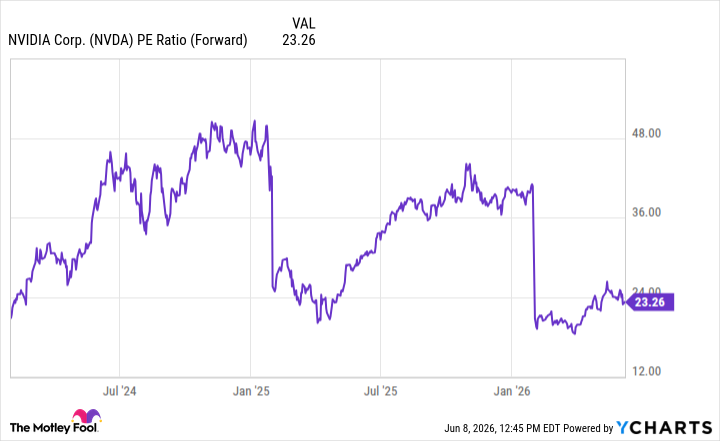
NVDA PE Ratio (Forward) data by YCharts
As AI workloads become more complex and demanding, the need for versatile, high-performance GPUs continues to grow, even for Nvidia's competitors. The SpaceX-Google agreement serves as compelling evidence that Nvidia's role in AI data centers is not only secure but increasingly foundational to the industry's future. The fact that a leading ASIC developer like Google is outsourcing capacity needs to a rival's technology underscores Nvidia's enduring competitive advantage. This deal is a powerful indicator that Nvidia's dominance in the AI chip market is more robust than widely recognized, solidifying its position as the essential enabler of AI infrastructure.