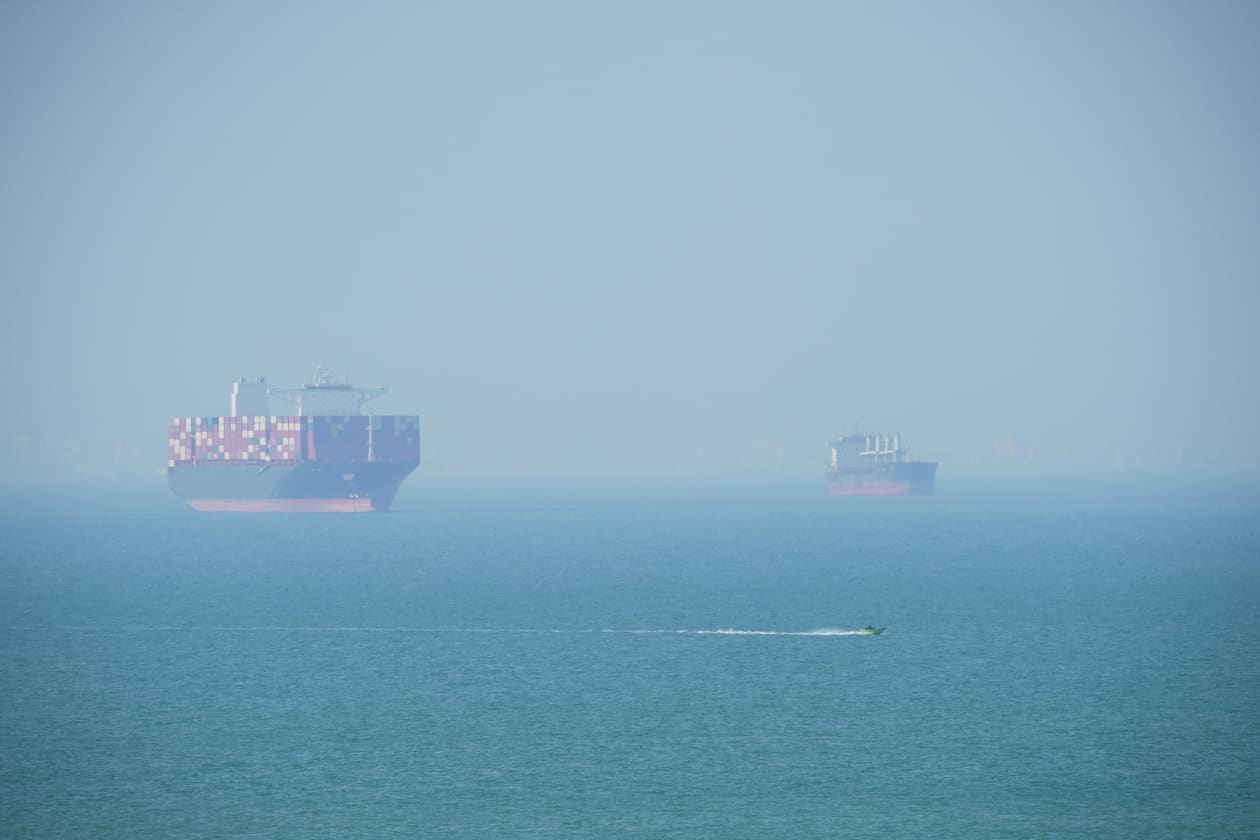
Former President Donald Trump announced a controversial 20% toll on all cargo shipped through the Strait of Hormuz, declaring the U.S. as its ‘guardian’ and simultaneously reinstating a blockade on Iranian ports. This move, which comes amidst escalating U.S.-Iran hostilities and is widely considered illegal under international law, sent immediate tremors through global markets, causing oil prices to surge and stock indexes to fall.

In a bold and controversial declaration, former President Donald Trump announced Monday that the United States would impose a substantial 20% fee on all cargo navigating the critically important Strait of Hormuz. Simultaneously, Trump confirmed the immediate reinstatement of a blockade on Iranian ports near the strait, effective Tuesday at 4 p.m. ET, as verified by U.S. Central Command.
Trump, who proclaimed America the 'guardian' of the major oil shipping route, elaborated on his intentions at the White House: 'We're attacking them tonight, and we're taking out all of their capability for anything having to do with the strait. And I think in the end, we will end up controlling the whole thing.'
This aggressive policy comes despite the U.S. having previously rejected Iran's own plans to charge tolls, a practice widely considered illegal under international law by maritime experts, regulators, and even top Trump administration officials. Rather than advocate for the strait's return to its pre-conflict, toll-free international status, Trump's directive means commercial vessels must now pay 'protection money' to the U.S.
Following Trump's announcement, global markets reacted swiftly: oil prices jumped significantly, and stock indexes fell. Despite previous disruptions that choked off 20% of the world's oil trade, Trump affirmed on Truth Social that the strait 'is OPEN, and will remain OPEN, with or without Iran,' ensuring all countries, excluding Iran, would have 'fair and open use.' This assertion comes amid new exchanges of fire between the U.S. and Iran, further complicating peace efforts and slowing tanker traffic to a trickle.
The former president justified the toll: 'The U.S.A. will be, from this point forward, known as 'THE GUARDIAN OF THE HORMUZ STRAIT.' But as such, and as a matter of FAIRNESS, will be reimbursed, at the rate of 20% on all cargo shipped, for any and all costs necessary to do the job of providing safety and security to this very volatile section of the World.' He added that 'The process and formation will begin immediately.'
In a July 10 letter to the Senate, Trump disclosed that the U.S. initiated new military action against Iran on July 7, in compliance with the War Powers Resolution. This occurred despite Congress having passed a largely symbolic measure directing an end to U.S. hostilities in Iran last month.
Many specifics regarding the proposed reimbursement policy remain unclear, with no immediate response from the White House to inquiries. Iranian Foreign Minister Abbas Araghchi, however, swiftly countered on X, claiming Iran's control of the strait and its right to compensation. '20% is of course too much. We will be fair,' Araghchi wrote.

The United Nations' International Maritime Organization (IMO) sharply criticized the plan, telling CNBC that it 'stands firmly against charging fees for passage through straits used for international navigation,' asserting there is 'no legal basis' for such tolls. This aligns with earlier statements from U.S. Secretary of State Marco Rubio, who previously stated, 'No country is allowed to charge tolls or fees on an international waterway. That's existing international law.'
While the U.S. has a history of offering protection in the Persian Gulf, such as for Kuwaiti ships in the 1980s, David Goldwyn, president of Goldwyn Global Strategies and a former Obama administration special envoy, called the 20% charge 'quite an extortionate level.' He also questioned the U.S.'s ability to ensure safe passage, dismissing the announcement as 'bluster.'
Trump had previewed this policy in a Fox News interview, saying the U.S. would 'get paid for guarding' the strait and might even 'run it.' He emphasized that the U.S. could no longer 'do that for nothing.' This move follows the collapse of a temporary ceasefire deal with Iran, which had explicitly prohibited Tehran from imposing any charges, a deal Trump declared 'over' last week.
This latest announcement solidifies Trump's previous hints on Truth Social about U.S.-imposed tolls for 'services rendered as the Guardian Angel to the countries of the Middle East,' particularly after the erosion of the ceasefire agreement.