


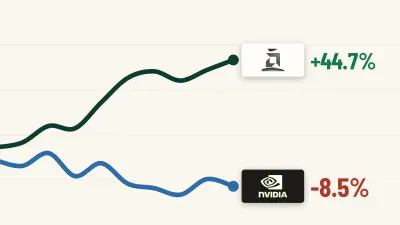
AMD has significantly outperformed Nvidia, achieving the widest performance gap since Nvidia’s 1999 IPO. AMD’s stock surged 44.7% while Nvidia’s fell 8.5% in a recent five-day period.
This divergence is driven by AMD’s record revenue and strong data center performance, coupled with a significant cloud deal with Google. Conversely, Nvidia faces market uncertainty following the resignation of its CEO, Jensen Huang.
In a dramatic shift reminiscent of the early days of the tech boom, Advanced Micro Devices (AMD) has achieved the widest performance margin over Nvidia since the latter’s 1999 initial public offering. Over a recent five-day trading period, AMD surged by an impressive 44.7%, while Nvidia experienced a notable decline of 8.5%. This significant divergence highlights a pivotal moment for the semiconductor giants, driven by contrasting company developments.
The substantial 53.2-percentage-point gap between AMD and Nvidia's stock performance marks a historic moment. This period saw AMD climb from $404.40 to $585.30, showcasing robust investor confidence. Conversely, Nvidia's stock fell from $181.60 to $166.19, reflecting market uncertainty.
AMD's recent success can be attributed to several key factors. The company announced record third-quarter revenue of $13.4 billion, a 45% increase year-over-year, with its data center segment experiencing a remarkable 97% surge. This strong performance directly competes with Nvidia's core market. Further bolstering AMD's position, the company secured a significant cloud deal with Google for its fifth-generation EPYC chips. Additionally, CoreWeave, a prominent player in cloud infrastructure, relies heavily on AMD's processors, and a recent Goldman Sachs listing highlighted AMD as a preferred chip investment.
In stark contrast, Nvidia's recent performance has been overshadowed by leadership changes. The company announced that Jensen Huang has resigned as president, CEO, and director. While Colette Kress has been appointed interim CEO, the market is awaiting the selection of a permanent successor, leading to lingering uncertainty and impacting the stock's momentum. This marks Nvidia's sixth consecutive weekly loss.
Historically, the widest previous five-day spread favoring AMD occurred on April 22, 2016, with a 50.1-point gap when AMD rose 47.8% and Nvidia fell 2.3%. The current situation, however, is amplified by Nvidia's steeper decline.
| Five Days Ending | AMD Minus Nvidia |
|---|---|
| Nov. 12, 2026 | 53.2 points |
| Apr. 22, 2016 | 50.1 points |
| Jun. 28, 2002 | 45.1 points |
| Oct. 8, 2025 | 42.6 points |
AMD's strong growth outlook is supported by management's projection of over 80% revenue growth in 2027, with the data center segment expected to constitute more than 80% of total sales. Despite a trailing P/E ratio of 202, which offers little room for error, AMD presents a compelling growth narrative.
While AMD's stock experienced a notable dip of 8.75% on Friday, closing at $534.06, the company's fundamentals and growth prospects remain strong. Nvidia, on the other hand, faces the challenge of regaining market confidence through a decisive leadership appointment. Until then, AMD appears to hold the clearer growth story in the competitive semiconductor landscape.
 6:08
Play: 2026's Biggest AI Trends: The Return of CPUs | INTC Stock, AMD Stock, NVDA Stock
2026's Biggest AI Trends: The Return of CPUs | INTC Stock, AMD Stock, NVDA Stock
Subscribe free on YouTube





