In the fiercely competitive landscape of global corporations, Apple (AAPL) and Alphabet (GOOG, GOOGL) currently hold the prestigious positions of the world's second and third largest companies, respectively. With Apple's market capitalization hovering just under $5 billion and Alphabet's at a significant $4.2 billion, the gap might seem substantial. However, an insightful analysis suggests that Alphabet is strategically positioned to close this difference and claim the title of the world's second-largest company within the next year, well before the end of 2027. This ambitious forecast is supported by two critical factors: their contrasting approaches to artificial intelligence and their current valuation dynamics.
AI: A Tale of Two Strategies
Apple and Alphabet are navigating the transformative wave of artificial intelligence with fundamentally different philosophies. Apple has adopted a notably restrained approach, investing minimally in large language models and dedicated AI computing infrastructure. Instead, the tech giant plans to integrate Google Gemini into most of its product ecosystem, sidestepping heavy internal development costs. While this could prove to be a financially astute move, it inherently limits Apple's AI capabilities to what Gemini can offer.
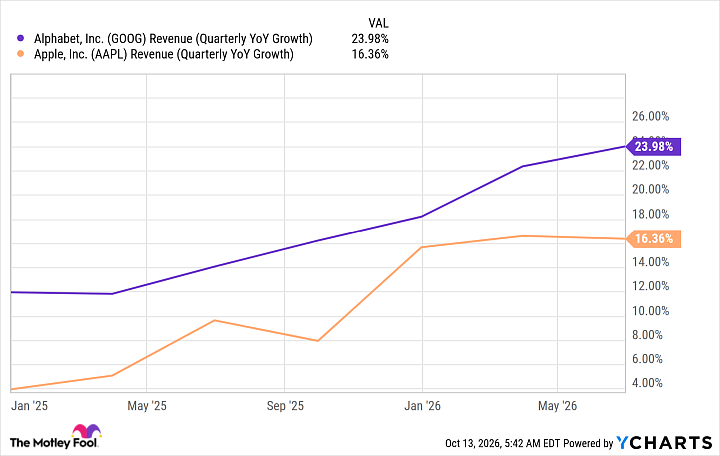
Conversely, Alphabet has gone 'all-in' on AI, making significant investments in data centers and cutting-edge research. For a period, Apple's cautious stance has made it a somewhat unique 'safe-haven' investment within big tech, appealing to those looking to hedge against concentrated AI exposure. However, this sentiment is anticipated to shift. As investors increasingly recognize and value the substantial payoffs and long-term benefits of aggressive AI investment, the market's perception is expected to pivot, potentially redirecting capital away from Apple's more conservative growth trajectory.
GOOG Revenue (Quarterly YoY Growth) data by YCharts
Valuation: A Premium vs. Growth Opportunity
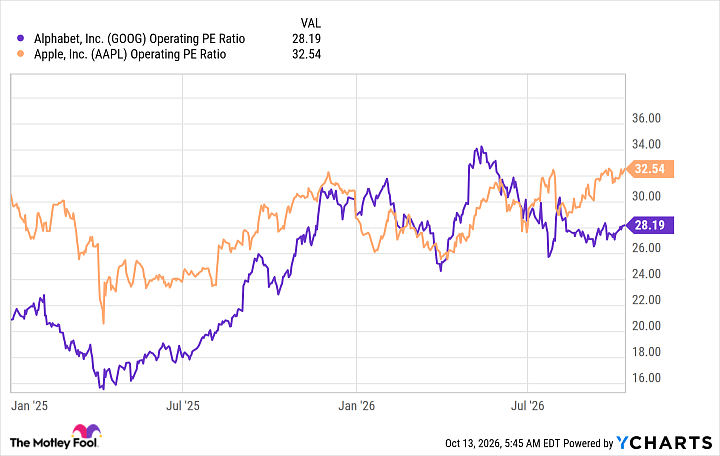
Beyond AI strategy, Apple currently commands a premium valuation compared to Alphabet. To provide a more accurate comparison, especially given that Alphabet's standard Price-to-Earnings (P/E) ratio is distorted by significant gains from investments in companies like SpaceX and Anthropic, the price-to-operating-earnings (P/OE) ratio offers a clearer picture by focusing solely on earnings from core business operations.
GOOG Operating PE Ratio data by YCharts
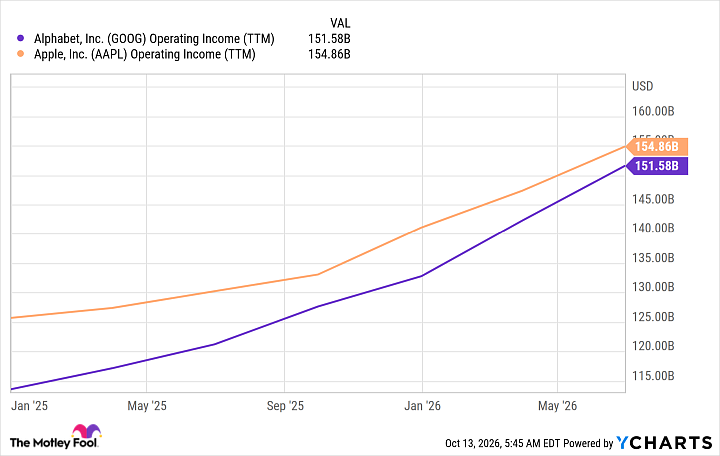
While their valuations were closely aligned earlier this year, a modest divergence has since emerged. Even if they traded at identical valuations, Apple would still hold a slight lead. However, Alphabet's projected significantly faster growth between now and the end of 2027 means it is on track to generate substantially higher operating income than Apple.
GOOG Operating Income (TTM) data by YCharts
Should Alphabet successfully overtake Apple in operating income generation, combined with a market sentiment shift that increasingly favors its AI-centric investments, the stage will be set for Alphabet to surpass Apple and become the world's second-largest company by 2027. This trajectory suggests Alphabet could deliver market-beating returns, making it an enticing investment opportunity now.