


This article compares Alphabet and Micron Technology as AI investment opportunities. While Alphabet offers a long-term, diversified AI strategy with steady growth in cloud and search, Micron presents explosive short-term growth driven by surging data center demand for memory chips. Despite Micron’s current impressive revenue spikes and seemingly cheaper valuation on projected earnings, its future beyond 2027 carries significant risks, making Alphabet the safer, less volatile long-term AI stock.
In the burgeoning world of artificial intelligence (AI) investing, diverse strategies exist. One path leads to established tech giants like Alphabet (GOOG, GOOGL), which are deeply embedding AI across their product ecosystems, developing proprietary AI models, and constructing robust cloud computing infrastructure to support both internal and external AI workloads. Alternatively, investors can opt for an infrastructure-focused play, such as Micron Technology (MU), a key supplier of memory chips essential for data center applications.
Both companies have proven to be lucrative investments over the past year. But when scrutinizing their current prospects, which one presents a more compelling stock pick right now?

Image source: Getty Images.
Alphabet: The Architect of Enduring AI Gains
Alphabet's AI strategy is comprehensive and appears to be yielding success across numerous fronts. Its Gemini generative AI platform is gaining widespread adoption, seamlessly integrated into Google Search to provide AI-powered summaries for almost every query. Furthermore, Alphabet's cloud computing division is flourishing, reporting an impressive 63% revenue growth in Q1. The sustained strong performance across these business units signals continued robust growth for the company.

NASDAQ: GOOGL
Micron, however, faces a different future. As a manufacturer of memory chips for computing hardware and long-term storage, Micron is currently riding a wave of unprecedented demand fueled by the massive global data center build-out. The critical question for Micron investors is: what happens when this data center construction frenzy subsides? The memory market landscape will likely shift dramatically. While a baseline demand for new and replacement computing units will persist, it's improbable to match the current peak demand levels.
Therefore, from a profound, long-term investment horizon (a decade or more), Alphabet emerges as the superior stock to acquire.
Winner: Alphabet
Micron: A Sprint of Astounding Growth
While Alphabet holds the long-term advantage, Micron is delivering spectacular short-term performance. In its most recent quarter, revenue surged by an astonishing 346% year-over-year, reaching $41.5 billion and significantly surpassing its own guidance of $33.5 billion. Looking ahead, Micron projects $50 billion in revenue for the next quarter. Adding to investor optimism, Micron's management has indicated that escalating memory chip demand and persistent supply constraints are expected to continue beyond 2027.

NASDAQ: MU
Alphabet, despite its considerable scale, demonstrated robust growth, with revenue increasing 22% year-over-year in Q1 to over $109 billion. This is commendable for a mature enterprise. However, when compared to Micron's staggering growth rates, it operates on a different magnitude.
Winner: Micron
The Intricate Dance of Valuations
Evaluating the valuations of two companies with vastly different growth trajectories, long-term prospects, and distinct fiscal year calendars is inherently complex. Alphabet, with its consistent yet not extraordinary growth, is more straightforward to assess. It trades at a forward price-to-earnings (P/E) ratio of 24, which is fairly standard for a leading tech stock, and aligns with the calendar year for its fiscal reporting.
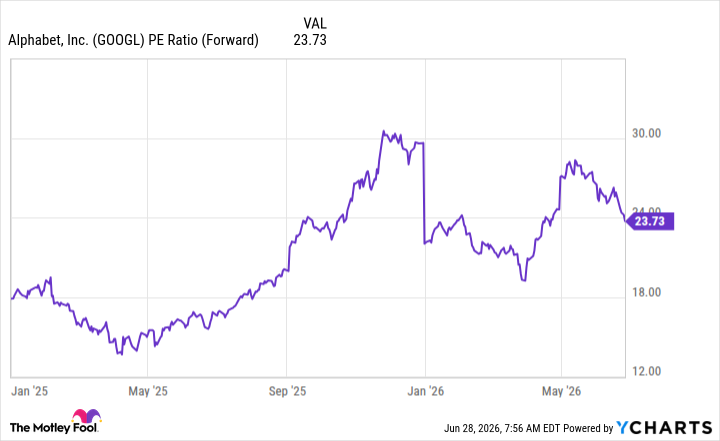
GOOGL PE Ratio (Forward) data by YCharts.
Micron, however, defies traditional valuation metrics. Its fiscal year concludes in August, necessitating the use of fiscal 2027 and 2026 earnings projections for a clearer picture. From this vantage point, Micron's stock surprisingly appears undervalued, even after its significant appreciation this year.
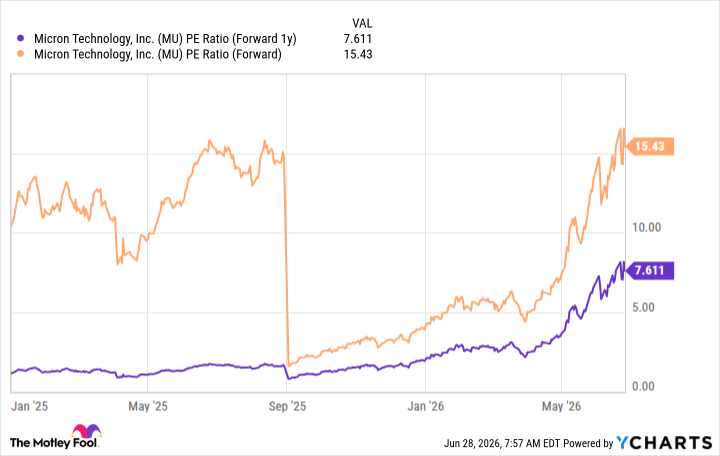
MU PE Ratio (Forward 1y) data by YCharts.
The challenge lies in valuing a company whose core business strength might diminish post-2027 if data center demand cools or if memory chip production overwhelms the current shortage. This inherent uncertainty makes Micron's valuation complex. Nevertheless, with such rapid earnings growth and an attractive projected valuation, it's difficult to disregard. Given Micron's significantly cheaper valuation on a projected earnings basis compared to Alphabet, it takes the win in this category.
Winner: Micron
Choosing Your AI Champion
Despite Micron's victory in this analysis, it might not be the ideal investment for every portfolio. It demands diligent monitoring and faces considerable execution risks beyond 2027. However, it holds strong potential for substantial gains in the coming few years. For investors who prioritize stability and lower volatility over potentially outsized returns, Alphabet remains a robust and reliable AI stock selection, promising steady, long-term growth in the evolving AI landscape.






