

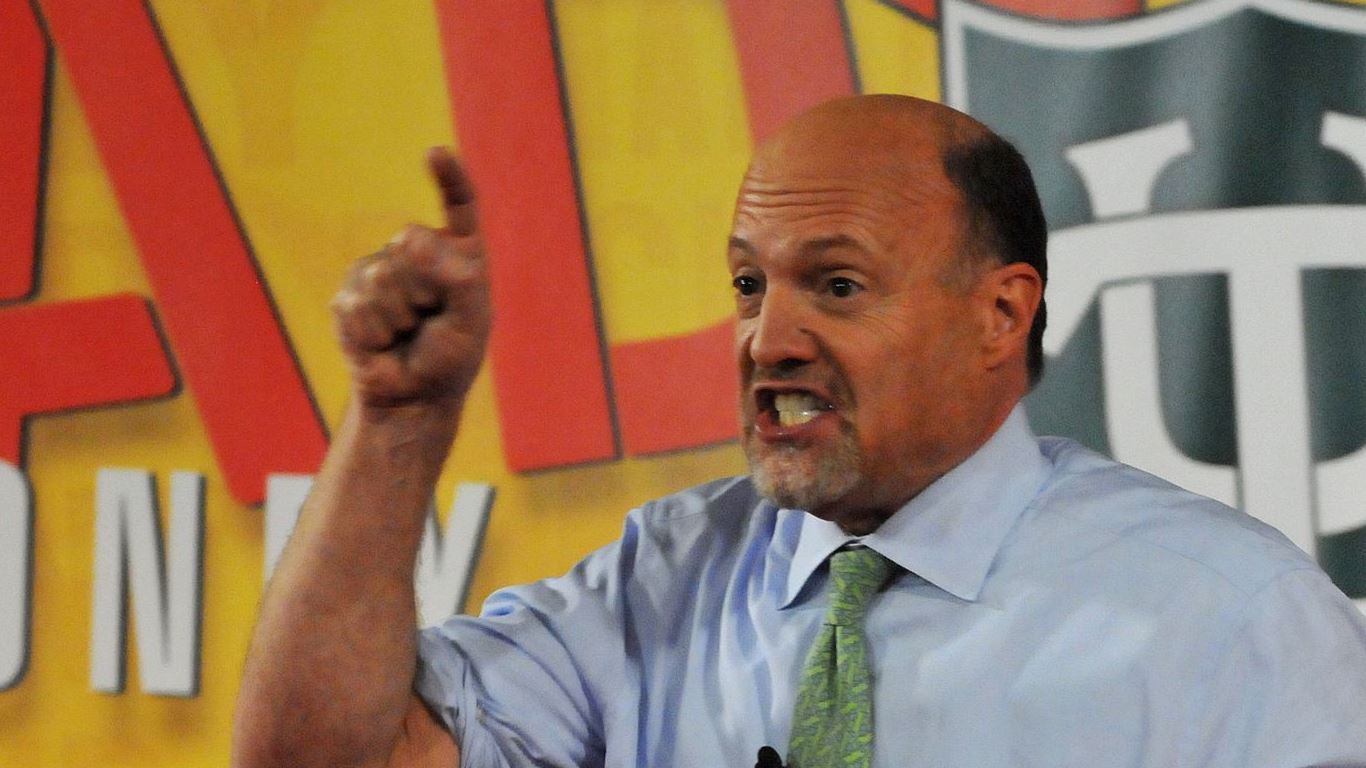
Jim Cramer provided critical investment advice for a first-time homebuyer looking to rebuild their portfolio after a large down payment: “Expect corrections and don’t rely on hope as an investing strategy.” He recommends a 50/50 split of new contributions between five well-researched individual stocks and an index fund, with the choice of Nasdaq-100 or S&P 500 depending on the investor’s time horizon. Cramer also suggests an optional small allocation to Bitcoin as a hedge, emphasizing consistent, disciplined investing over hoping for market rallies.
In a candid exchange on a recent episode of Mad Money, financial pundit Jim Cramer offered a stark reality check to a first-time homebuyer facing the daunting task of rebuilding their investment portfolio. His unequivocal advice: “Expect corrections and don’t rely on hope as an investing strategy.”
The young investor had recently committed a substantial portion of their investment assets to a down payment on a new home, leaving their brokerage balance close to zero. The challenge now is to strategically replenish those funds, recognizing that any misstep driven by "hope" could impede portfolio growth for years.
Cramer’s Prudent 50/50 Portfolio Rebuild Strategy
Cramer advocates a refreshingly straightforward, yet often underutilized, portfolio framework. The core principle involves splitting all new contributions evenly: 50% allocated to five individual stocks the investor genuinely understands and believes in, and the remaining 50% directed into a broad index fund. For those seeking an optional layer of insurance, a small allocation to cryptocurrency, specifically Bitcoin, is suggested over traditional gold vehicles like GLD. This strategy is firmly rooted in realism, urging investors to abandon the complacent assumption that market prices will perpetually rise.
Consider a hypothetical $600 monthly contribution. Under Cramer's model, $300 would be invested in an index ETF. The other $300 would be distributed among five chosen stocks, roughly $60 per name. If an investor were to select the five largest Nasdaq holdings today, they would acquire fractional shares of tech giants such as NVIDIA (NASDAQ:NVDA), Microsoft (NASDAQ:MSFT), Apple (NASDAQ:AAPL), Amazon (NASDAQ:AMZN), and Alphabet (NASDAQ:GOOGL). Cramer emphasizes that consistent, disciplined investing, even with fractional shares, ultimately outperforms the elusive pursuit of perfect market entry points.
Highlighting the potential for significant upside, Cramer posits: “One of them could hit big, another one could hit big, and next you know, you are a millionaire because of the individual stock side.” Recent market performance underscores this asymmetric potential; for instance, Alphabet surged 128% over the past year, while Microsoft experienced a 7% decline within the same period. Owning a diversified set of five individual stocks significantly increases the probability of catching a market winner, mitigating the risk inherent in betting on just one.
Index Selection: Navigating Time Horizons with NDX or S&P
The choice of index fund is critical and hinges entirely on the investor's time horizon, which Cramer directly links to age. For younger investors with a long runway, his directive is clear: “You’re young, do the Nasdaq-100 fund, not the S&P.”
A look at historical data reveals the trade-offs. A Nasdaq-100 tracking fund has delivered a robust 17% year-to-date gain and an astounding 562% return over the last decade. In contrast, an S&P 500 tracker achieved 9% year-to-date and 259% over the same ten-year span. While the tech-heavy Nasdaq-100 offers higher potential returns, it naturally concentrates risk.
For individuals with 30 years or more until they require their investment capital, the heightened volatility of the Nasdaq-100 can be advantageous. They have the luxury of riding through market drawdowns and capitalizing on subsequent recoveries. However, for those with a shorter horizon of 10 years or less, the S&P 500’s broader market composition provides a cushioning effect against sharp market corrections. The VIX, a key measure of market volatility, averaged around 18 over the past year and briefly spiked to 31 in March, serving as a stark reminder that market corrections are a recurring reality.
The Optional Hedge: Bitcoin vs. Gold
Cramer's recommended "insurance layer" is precise: Bitcoin as the primary hedge, with a gold ETF or physical bullion as a secondary, more distant option. Interestingly, recent performance data presents a contrasting picture. Over the last year, gold appreciated by 36%, while Bitcoin saw a 30% decline. Nevertheless, a modest 5% to 10% allocation to commodities can help smooth overall portfolio returns without significantly impeding the compounding power of the equity side.
Immediate Action Steps for Investors
- Establish Automated Contributions: Set a fixed monthly investment amount that aligns with personal affordability guidelines, ideally within the 28/36 rule alongside a new mortgage. Crucially, automate these contributions before the cash is even seen.
- Implement the 50/50 Split: Divide monthly contributions evenly: half into the chosen index fund and half across five individual stocks that the investor can confidently explain and justify to a peer.
- Tailor Index Selection to Horizon: For a long-term horizon (20+ years), opt for a Nasdaq-100 fund. If the capital is needed sooner (under 10 years), an S&P 500 fund offers more stability.
- Consider the Gold Sleeve (Cautiously): Introduce a commodity allocation, such as gold or Bitcoin, only after the core equity and index positions are well-funded. If this segment proves too tempting for frequent adjustments, it may be best to skip it entirely.
- Define Sell Rules Proactively: Write down clear, objective sell rules now, while emotions are detached. Cramer's direct warning resonates: “cut your losses and move to a stock you can actually see going higher under its own power, not because of hope, but because of reason.”
The journey to rebuild wealth after a significant down payment is often unglamorous. It demands consistent monthly deposits, a discerning selection of a few well-understood individual stocks, and a single index fund diligently working in the background. Investors must anticipate market drawdowns, plan for them methodically, and abandon the passive expectation that rising prices alone will secure their financial future.