In a battle for tech supremacy, Alphabet (GOOGL, GOOG) is making a strong comeback in the AI race, boosted by its Gemini model and AI-integrated Google Search. Its cloud division, Google Cloud, is also experiencing rapid growth. However, analysts project that Nvidia (NVDA) will continue its dominance due to its exceptional growth rate, fueled by the ongoing AI hardware demand. Despite Alphabet’s resurgence and strong future projections, it faces a significant challenge in closing the market cap gap with Nvidia.

In a significant showdown for market dominance, investors are closely watching the trajectory of tech titans Alphabet (GOOGL, GOOG) and Nvidia (NVDA). While Alphabet, currently the world's third-largest company with a market cap around $4 trillion, has shown impressive resurgence, particularly in the AI space, the question remains: can it surpass Nvidia, the current leader valued at approximately $5.4 trillion, by 2027? This ambitious goal presents a considerable challenge, but recent developments suggest it's a possibility worth exploring.

Image source: Getty Images.
The Resurgence of Alphabet in the AI Race
Just a year ago, Alphabet was perceived as struggling in the artificial intelligence landscape, marked by several product missteps and an AI model that fell short of competitors. The future of its core revenue stream, Google Search, was also under threat from AI advancements. However, the company has staged a remarkable comeback.
Alphabet's advanced AI model, Gemini, has significantly bolstered its position. Furthermore, the integration of AI-powered search overviews into Google Search has created what is likely the most widely used AI tool globally. This integration ensures Alphabet remains at the forefront of AI interaction.
The company's strategic investments in its cloud computing arm, Google Cloud, are also yielding impressive results. In the second quarter, Google Cloud reported a remarkable 82% growth, far exceeding that of other major cloud providers. With a substantial $200 billion planned for data center capital expenditures in 2026, Alphabet is poised to expand its computing capacity, potentially accelerating Google Cloud's growth even further.
These advancements have captured the attention of Wall Street analysts, who project 24% growth for Alphabet in 2026 and 23% in 2027. While these are robust figures, the critical question is whether they are sufficient to challenge Nvidia's leading position.

NASDAQ: GOOGL
Key Data Points
The Unstoppable Growth of Nvidia
Despite Alphabet's impressive comeback, the prevailing view is that Nvidia's growth trajectory is simply too formidable for Alphabet to match. The immense demand for Nvidia's AI-accelerating hardware, driven by the substantial AI investments from companies like Alphabet and its competitors, is expected to fuel another year of exceptional growth. Nvidia's CFO, Colette Kress, has indicated that management anticipates 70% growth in the coming year. Historically, Nvidia has a track record of exceeding its own guidance, suggesting that actual results could be even more spectacular.
If Nvidia achieves this projected growth, it would represent three years of growth for Alphabet. Compounding this challenge is Nvidia's existing $1.4 trillion market cap advantage. The current AI build-out appears robust and is expected to continue for several more years, making it highly unlikely that Alphabet can close the gap unless this fundamental thesis falters.

NASDAQ: NVDA
Key Data Points
Valuation and Outlook
When comparing the two companies' valuations, both Alphabet and Nvidia trade at similar multiples. However, Nvidia's price-to-earnings (P/E) ratio has seen a significant decrease over the past year, while Alphabet's has risen. This suggests that Nvidia is becoming a more attractive investment from a valuation standpoint, especially considering its growth prospects.
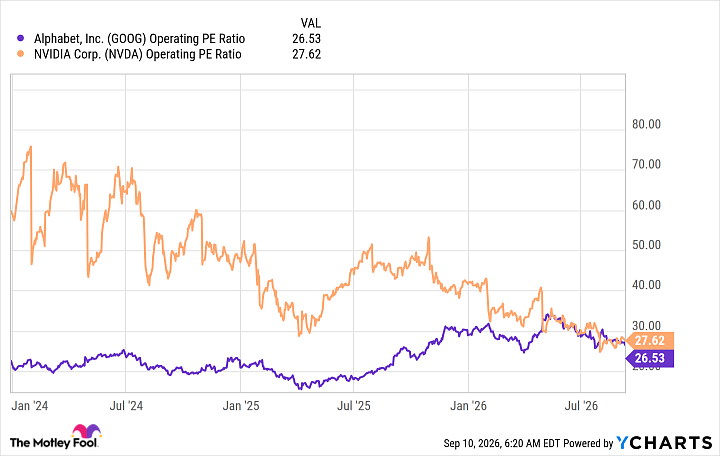
GOOG Operating PE Ratio data by YCharts
The rapid growth projected for Nvidia stands in stark contrast to Alphabet's anticipated expansion. If forced to choose which stock would perform better over the next year, given the same starting point, the one projected to grow at a 70% rate would likely be the favored choice. This principle applies to the comparison between Nvidia and Alphabet as well.
While Alphabet is a strong investment that is expected to outperform the market, its growth rate is unlikely to be sufficient to overtake Nvidia as the world's largest company. With the AI build-out anticipated to continue for several more years, Nvidia remains the top AI stock to consider for the near term. However, a balanced investment strategy incorporating both Nvidia's high growth potential and Alphabet's steadier growth trajectory could be a prudent approach for many investors.