





During SpaceX’s first earnings call as a public company, Elon Musk declared an exclusive partnership with Nvidia, positioning the chip giant as the sole provider for future AI infrastructure needs. Musk cited Nvidia’s Vera Rubin architecture as superior and highlighted the company’s strong partnership.
This decision contrasts with the multi-vendor approach of other tech giants and underscores Nvidia’s market dominance, evidenced by its significantly larger market cap and higher revenue growth compared to AMD.
Elon Musk Declares Loyalty: SpaceX Chooses Nvidia Over AMD for AI Dominance
The landscape of Artificial Intelligence (AI) chip manufacturing is largely defined by a powerful duopoly: Nvidia (NVDA) and Advanced Micro Devices (AMD). Nvidia is pushing the boundaries with its Blackwell platform and scaling up Vera Rubin for its next-generation rack-scale computing. Meanwhile, AMD is competing fiercely with its MI300 systems and gearing up its MI400 accelerators to maintain its market presence.
Major tech players like Amazon, Alphabet, Microsoft, Oracle, Meta Platforms, Anthropic, and OpenAI are adopting a multi-vendor strategy, integrating chips from both Nvidia and AMD. This approach is driven by supply constraints, the need for specialized architectures for different workloads, and the urgency to build AI infrastructure.
Against this backdrop, during the first earnings call of Space Exploration Technologies (SpaceX) as a public company, Elon Musk unequivocally revealed his preference in the chip sector.
Musk's Unwavering Bet on Nvidia
Musk left no room for ambiguity during the earnings call, stating:
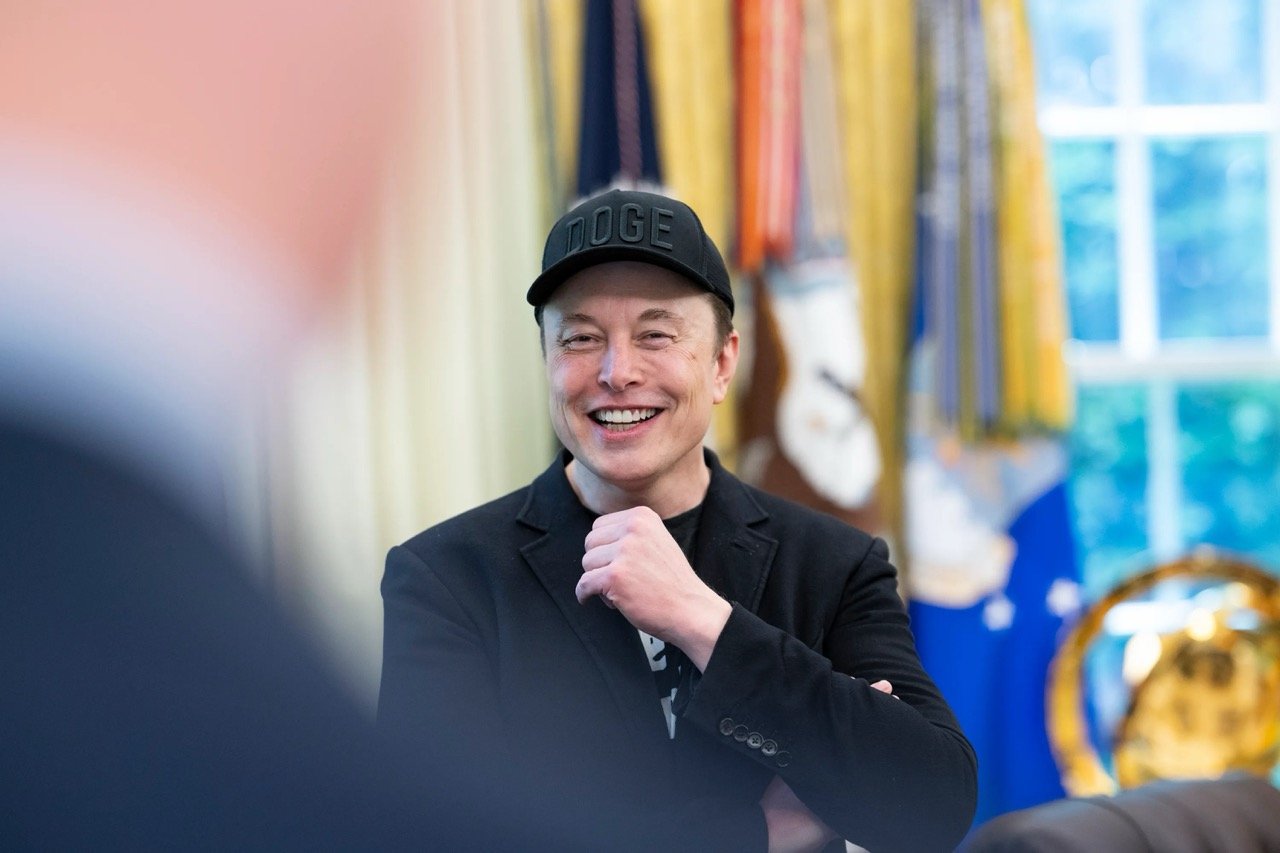
"Going forward, we've decided to build exclusively on Nvidia because we think the Vera Rubin architecture is the best architecture. We think it's the best AI computer, and we greatly value our close cooperation and partnership on many levels with Nvidia. So we're exclusive to Nvidia."
This decision is not entirely surprising, given Musk's long-standing relationship with Nvidia. Tesla has utilized Nvidia's hardware for training its autonomous driving systems, even as it develops its own inference chips. Musk has previously expressed his admiration for Nvidia CEO Jensen Huang, confirming that both Tesla and SpaceX would continue to procure Nvidia chips in large quantities. The SpaceX earnings call merely served to publicly affirm this existing partnership.
SpaceX's Strategic Use of Nvidia's AI Chips
AI chips are critical for SpaceX's ambitious projects beyond terrestrial applications. The company is leveraging GPU clusters for designing orbital data centers, enhancing Starlink operations, supporting Starship mission planning, and conducting simulations similar to Tesla's work on autonomous vehicles. A key development is Starmind, an optimized satellite payload built on Nvidia's Vera Rubin NVL72 system.
SpaceX has rapidly transformed its Nvidia chip procurement into a burgeoning AI infrastructure business. The company is leasing substantial Nvidia compute clusters, not just for training its proprietary generative AI model, Grok, but also for providing cloud services.
Anthropic has secured a cloud services agreement with SpaceX valued at $1.25 billion per month through 2029. This deal grants Anthropic access to compute capacity on SpaceX's supercomputers, Colossus and Colossus II, which house approximately 325,000 Nvidia GPUs.
Similarly, Google Cloud has committed $920 million per month for access to around 110,000 Nvidia GPUs, CPUs, memory, and networking equipment until mid-2029. More recently, Reflection AI entered a multiyear deal worth up to $6.3 billion for access to Nvidia GB300 chips, reportedly costing $150 million per month.

NASDAQ: NVDA
Key Data Points
Nvidia's Edge: A Clear Choice for Musk and Investors
For SpaceX and Tesla, Musk has backed the established leader in the semiconductor industry, a decision supported by compelling financial data.
Nvidia commands a market capitalization of approximately $5.3 trillion, dwarfing AMD's roughly $830 billion. In the second quarter, Nvidia's data center revenue soared to $89 billion, an impressive 117% year-over-year increase. While AMD also reported strong growth in its data center segment, with $6.7 billion in sales (a 107% year-over-year increase), it operates from a significantly smaller base. Nvidia not only leads in revenue but also demonstrates faster growth, a scale that AMD is currently far from matching.
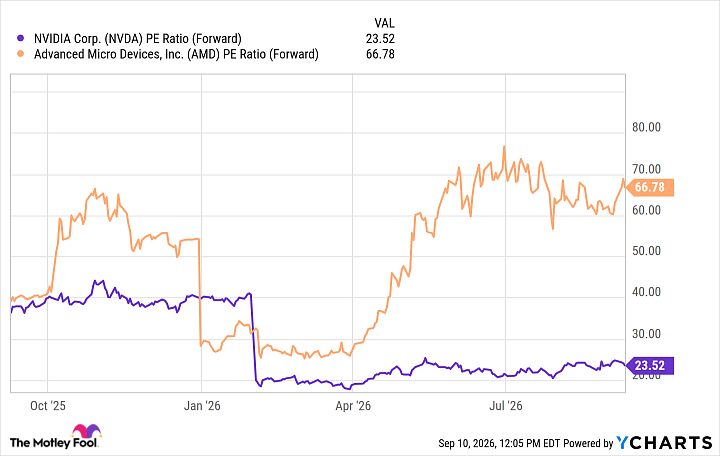
The valuation metrics further highlight the divergence between the two chip giants. Nvidia trades at a forward P/E ratio of approximately 23, whereas AMD commands a significantly higher multiple of around 67 times forward earnings. This suggests that investors are paying a substantial premium for AMD's future earnings potential, despite Nvidia's dominance in the software stack, rack-scale systems, and its strong customer base, which includes companies led by Elon Musk.
While AMD is unlikely to disappear and will continue to secure design wins, Musk's strategic decision appears to be a clear endorsement of Nvidia. His focus on trusted, high-performance platforms for his ventures, from rockets to AI factories, suggests a long-term commitment. For investors, this strategic alignment and Nvidia's market leadership present a compelling case.














