




A deep dive into the revenue trajectories of AI powerhouses Nvidia and Alphabet reveals distinct growth patterns. Nvidia demonstrates remarkably consistent quarter-over-quarter revenue increases, fueled by insatiable demand for its AI computing solutions, including its new Vera Rubin AI platform. Meanwhile, Alphabet, with its significantly larger revenue base primarily driven by digital advertising and a burgeoning Google Cloud segment, shows strong year-over-year sales growth despite seasonal fluctuations and recent legal scrutiny, leveraging AI demand through its cloud services.
In the high-stakes arena of artificial intelligence, two titans, Nvidia and Alphabet, present compelling yet distinct revenue narratives for investors. As the AI revolution accelerates, understanding their financial trends is crucial for assessing their market footprint and long-term potential.
Nvidia: The AI Engine with Accelerating Revenue
Nvidia (NVDA) stands at the forefront of AI hardware, generating its revenue predominantly from cutting-edge graphics, computational, and networking solutions vital for gaming and high-performance computing, especially AI applications. The company recently bolstered its offerings with new computational processors introduced in June 2026, a move that is clearly translating into robust financial performance. For the quarter ending April 26, 2026, Nvidia reported an impressive net income margin of 72%, a testament to its operational efficiency and market dominance.
What truly sets Nvidia apart is its consistent and accelerating sequential revenue increases, signaling an insatiable demand for its AI-enabling technologies. Even Alphabet counts among its key customers, highlighting Nvidia's foundational role in the AI ecosystem.
Alphabet: A Diversified Giant Scaling Its Vast Base
Alphabet (GOOGL), the parent company of Google, operates on a much larger revenue scale, primarily driven by its ubiquitous digital advertising services, expansive cloud computing infrastructure (Google Cloud), and diverse consumer hardware offerings. Despite facing scrutiny, including securities fraud investigations announced by multiple law firms in July 2026, Alphabet showcased formidable financial health, reporting a net income margin of 94% for the quarter ending June 30, 2026.
While its revenue stream is vast and influenced by the seasonal nature of the advertising industry, leading to significant spikes in the fourth quarter, Alphabet is also making massive strides in AI. Its Google Cloud business is a powerhouse, experiencing an astounding 82% year-over-year revenue growth to $24.8 billion in Q2. The backlog of customer orders for Google Cloud soared to over half a trillion dollars, up from $462 billion in Q1, underscoring the immense demand for its enterprise solutions and access to its proprietary AI models.
Decoding Revenue: What It Means for Investors
For retail investors, revenue is more than just a number; it's a critical indicator of a company’s fundamental health and growth trajectory. Representing the total money a company brings in before expenses, this metric offers insights into market penetration, operational scale, and the potential for future expansion. A growing revenue base often signifies increasing market share and customer adoption, crucial for long-term investment viability.
Quarterly Revenue at a Glance: Nvidia vs. Alphabet
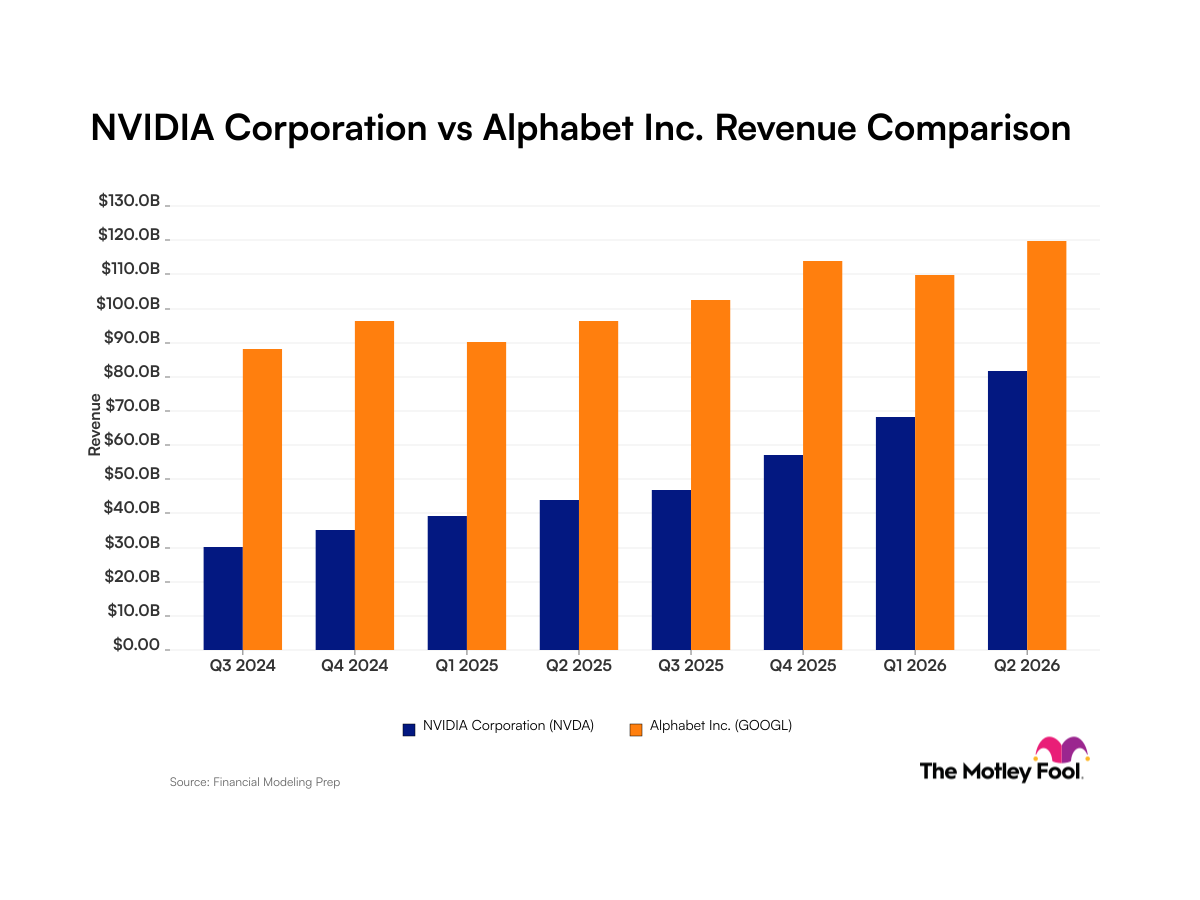
A direct comparison of their quarterly revenue figures paints a clear picture of their respective growth stories:
| Quarter (Period End) | Nvidia Revenue | Alphabet Revenue |
|---|---|---|
| Q3 2024 | $30.0 billion (period ended July 2024) | $88.3 billion (period ended Sept. 2024) |
| Q4 2024 | $35.1 billion (period ended Oct. 2024) | $96.5 billion (period ended Dec. 2024) |
| Q1 2025 | $39.3 billion (period ended Jan. 2025) | $90.2 billion (period ended March 2025) |
| Q2 2025 | $44.1 billion (period ended April 2025) | $96.4 billion (period ended June 2025) |
| Q3 2025 | $46.7 billion (period ended July 2025) | $102.3 billion (period ended Sept. 2025) |
| Q4 2025 | $57.0 billion (period ended Oct. 2025) | $113.9 billion (period ended Dec. 2025) |
| Q1 2026 | $68.1 billion (period ended Jan. 2026) | $109.9 billion (period ended March 2026) |
| Q2 2026 | $81.6 billion (period ended April 2026) | $119.8 billion (period ended June 2026) |
Data source: Company filings. Data as of July 31, 2026.
The Verdict: AI Fuels Growth in Different Ways
While both Nvidia and Alphabet exhibit robust year-over-year sales growth, their revenue trends diverge in interesting ways. Alphabet's advertising-centric business naturally experiences seasonal surges, particularly in the fourth quarter. However, the overarching theme for both is the undeniable boost from artificial intelligence demand.
Nvidia, in particular, showcases a remarkable trajectory of steadily rising quarter-over-quarter revenue. This consistent escalation underscores the immense and sustained demand for its AI computing solutions. With its new Vera Rubin AI platform anticipated to further fuel sales, the company projects continued acceleration, forecasting revenue to climb from $81.6 billion in its most recent quarter to $91 billion in the next.
Alphabet, too, is reaping enormous benefits from AI, though its impact is somewhat diffused within its massive advertising sales. Crucially, the spectacular performance of its Google Cloud division—boasting 82% year-over-year revenue growth to $24.8 billion in Q2 and a backlog exceeding half a trillion dollars—highlights its successful strategy in the burgeoning AI market. Through Google Cloud, customers gain access to Alphabet's proprietary AI models, demonstrating the company's prowess in capturing a significant share of the enterprise AI client base.