The excitement surrounding IPOs can lead investors to buy shares on their debut, but data suggests waiting is often more prudent. Stocks like SpaceX and most of the ‘Magnificent Seven’ have historically seen their prices fall below the IPO price within their first year. Companies like Microsoft and Alphabet, which were already profitable and growing rapidly at the time of their IPOs, are rare exceptions. Investors considering IPOs should practice patience or use dollar-cost averaging to manage early volatility.
READ MORE FROM THE MOTLEY FOOL
The allure of a hot Initial Public Offering (IPO) can be powerful, drawing investors into a frenzy to own a piece of the next big thing. However, seasoned investors know that resisting the urge to buy on the IPO date is often the wisest move. Historical data, including prominent tech giants like SpaceX and the 'Magnificent Seven' stocks, suggests that the market frequently offers a better entry point within the first year of trading.
Consider the recent case of Space Exploration Technologies (SPCX -3.41%), commonly known as SpaceX. While the initial excitement might be palpable, the data indicates a trend where IPO prices are often surpassed by lower trading prices within the subsequent year. This pattern is not isolated; it has been observed in the performance of five of the seven 'Magnificent Seven' technology stocks. The exceptions, Microsoft (MSFT +3.02%) and Alphabet (GOOG +6.88% / GOOGL +6.73%), then known as Google, highlight the importance of underlying financial strength.
Image source: Getty Images.
SpaceX and Magnificent Seven Stocks IPO-Related Overview
| SpaceX + Magnificent Seven Stocks | Market Cap | IPO Date | Split-Adjusted IPO Price (Price at Time) | Profitable When IPO'd? | Split-Adjusted Price Range During Year After IPO* |
|---|
| SpaceX | $1.4 trillion | June 12, 2026 | $135 | No | $107.01-$225.64 |
| Nvidia (NVDA +2.93%) | $4.9 trillion | Jan. 1999 | $0.04 ($12) | Yes | $0.03-$0.10 |
| Apple (AAPL -7.35%) | $4.5 trillion | Dec. 1980 | $0.10 ($22) | Yes | $0.06-$0.16 |
| Alphabet | $4.4 trillion | Aug. 2004 | $2.13 ($85) | Yes | $2.13-$7.95 |
| Microsoft | $3.5 trillion | March 1986 | $0.07 ($21) | Yes | $0.07-$0.30 |
| Amazon (AMZN +15.32%) | $2.9 trillion | May 1997 | $0.075 ($18) | No | $0.07-$0.35 |
| Meta Platforms (META +3.28%) | $1.4 trillion | May 2012 | $38 ($38) | Yes | $17.55-$45 |
| Tesla (TSLA +0.76%) | $975 billion | June 2010 | $1.13 ($17) | No | $1.05-$2.43 |
Sources: Yahoo! Finance, YCharts, and select Securities and Exchange Commission (SEC) filings. *Price ranges include intra-day prices. Data to July 31, 2026.
Alphabet and Microsoft: The exceptions
Search engine leader Alphabet -- then known as Google -- and software behemoth Microsoft stand out as the only Magnificent Seven stocks that did not dip below their IPO price in the year following their debut. The key differentiator appears to be their strong financial foundation: both companies were not only profitable at the time of their IPOs but had a history of consistent, rapid profit growth. This robust performance naturally fueled investor confidence and demand from the outset.
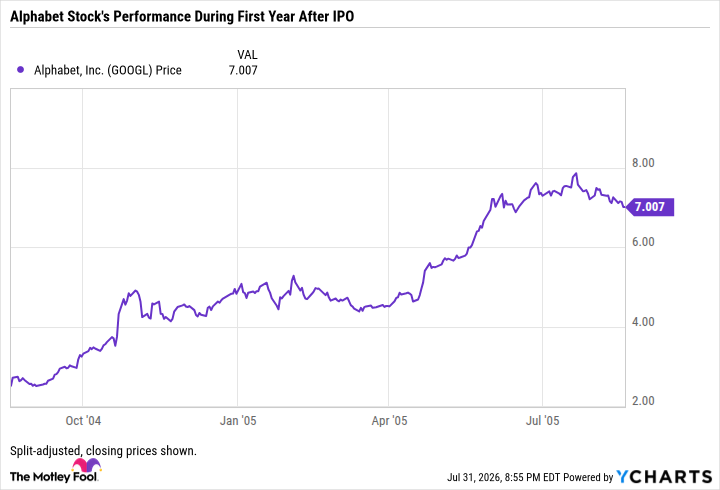
Data by YCharts.
While a specific chart for Microsoft's IPO performance isn't available due to data limitations, the underlying principle remains consistent. The lesson from these market leaders is clear: patience often pays off. For those who feel compelled to invest on an IPO date, employing strategies like dollar-cost averaging can help mitigate the inherent volatility of early trading days.