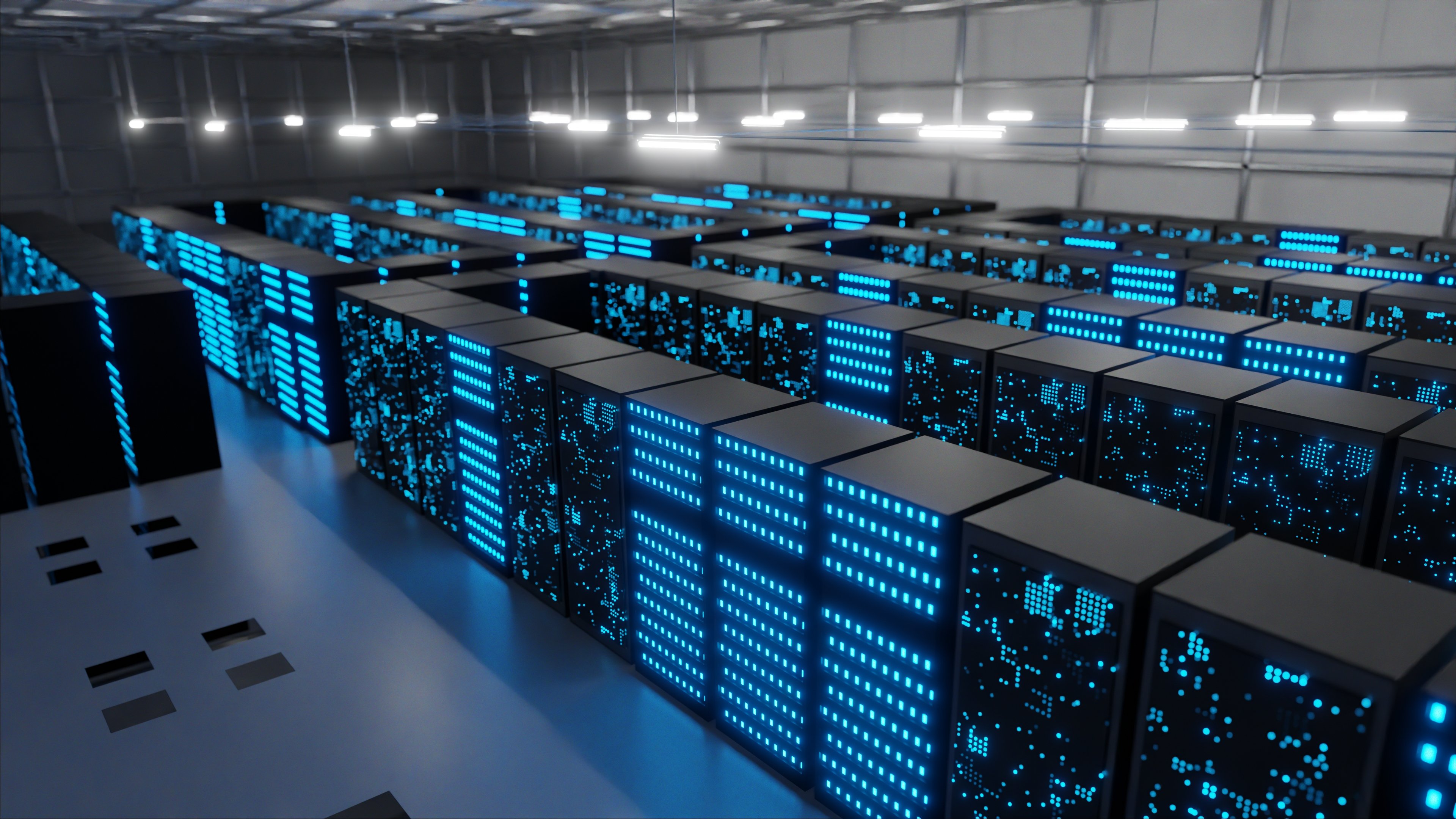
The ongoing build-out of artificial intelligence (AI) infrastructure is sparking intense debate: Is it a bubble ready to burst? The sheer volume of capital directed towards constructing AI data centers is staggering. The four dominant hyperscalers – Amazon (AMZN), Microsoft (MSFT), Alphabet (GOOGL, GOOG), and Meta Platforms (META) – are collectively poised to invest over $700 billion this year alone. To put this in perspective, that sum surpasses the gross domestic product (GDP) of all but approximately two dozen nations last year.
When viewed as a percentage of global GDP, current AI spending levels are indeed approaching thresholds seen in prior market bubbles. Goldman Sachs forecasts total AI capital expenditures to hit around $765 billion by 2026. Against a projected U.S. GDP of $32.4 trillion, this would represent 2.4%, a figure higher than the investment peaks observed in previous innovation cycles, notably the dot-com bubble.
However, today's global economy is far more interconnected than it was a quarter-century ago. From this broader perspective, AI spending is projected to constitute only about 0.6% of the estimated $126 trillion global GDP in 2026. While the leading hyperscalers are U.S.-based entities, their operations are inherently global, with AI data centers being established across the world.
Valuations Offer a Different Picture
Examining stock valuations reveals a significantly different landscape compared to the dot-com era. During that period, hardware companies such as Cisco and Sun Microsystems commanded exorbitant forward price-to-earnings (P/E) multiples, with Cisco’s peaking above 100x in 2000.
In contrast, Nvidia (NVDA), a pivotal player in the AI space, trades at a relatively modest forward P/E of 23.5 times fiscal 2027 analyst earnings estimates. Similarly, memory giant Micron Technology (MU) trades at an even lower multiple of just 6.5 times fiscal 2027 estimates. This demonstrates investor awareness of memory market cycles and a more measured, rational enthusiasm.
Certainly, some outliers exist. Space Exploration Technologies (SPCX) launched with an exceptionally high valuation, yet it represents an exception rather than the norm. Companies associated with Elon Musk, like Tesla (TSLA), have historically been granted a 'benefit of the doubt,' often commanding premium valuations.
Palantir (PLTR) also exhibits a frothy valuation, trading at a forward price-to-sales (P/S) ratio of 42 times. However, most software-as-a-service (SaaS) stocks have actually seen their multiples dramatically reduced. This stands in stark contrast to the dot-com boom, when nearly every internet company, regardless of business model viability, experienced skyrocketing stock prices.
Crucially, the hyperscalers driving the bulk of this AI investment are among the world's most formidable companies. They possess robust core businesses that generate substantial operating cash flow, which helps fund their significant AI infrastructure expenditures.
For investors concerned about a potential AI bubble but still eager to capitalize on AI's upside, these hyperscalers offer an ideal entry point. They each boast strong foundational businesses that are already benefiting from AI integration. This creates a 'win-win' scenario: either their AI investments yield returns that boost stock performance, or they scale back spending, leading to increased free cash flow. This resilient position is precisely why Amazon, Alphabet, and Meta Platforms remain top stock picks right now.