



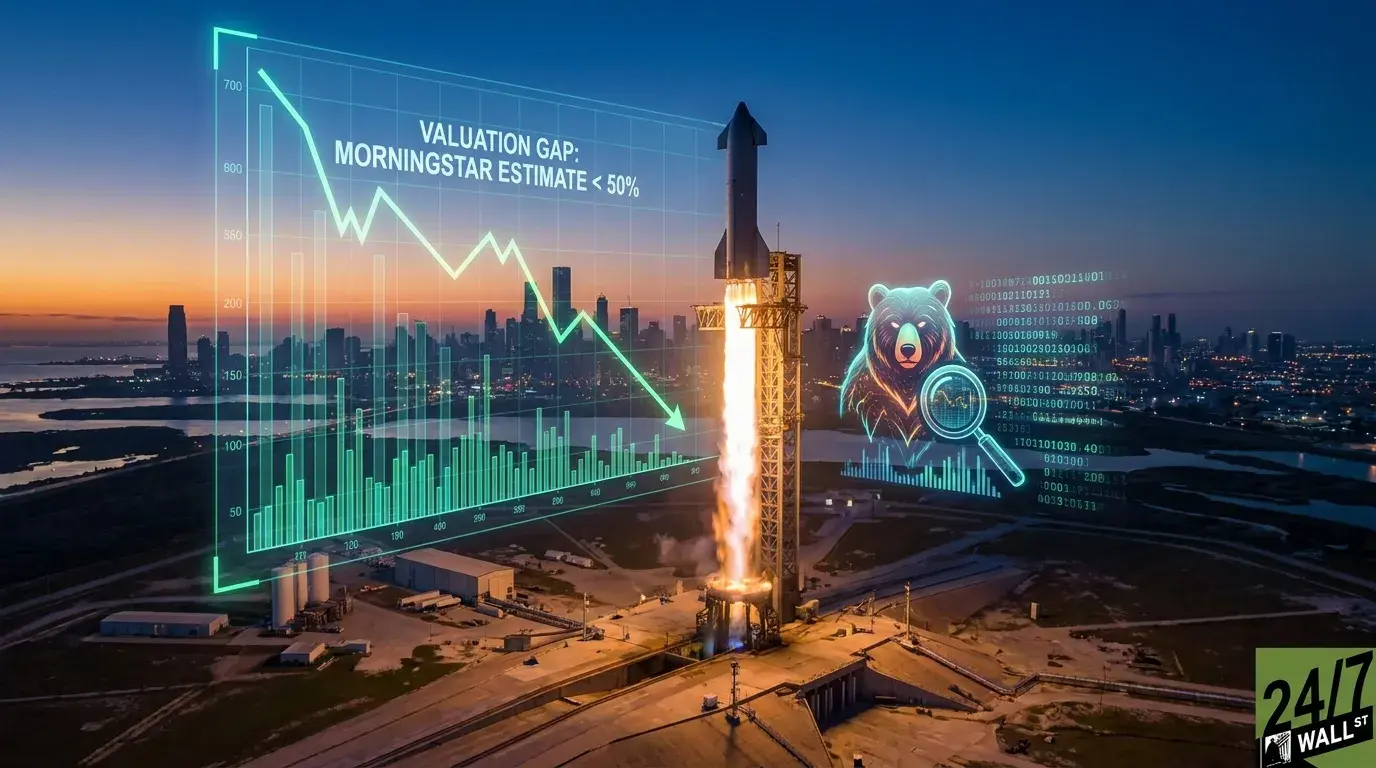
Morningstar analysts are casting significant doubt on SpaceX’s massive reported valuation of $2.44 trillion, suggesting its true fundamental worth could be less than half, even as the company prepares for a highly anticipated IPO priced around $1.75 trillion. The skepticism stems from SpaceX’s lack of profitability and traditional financial metrics, despite its operational dominance in space launches and its Starlink internet constellation. The debate highlights the challenge for SpaceX to justify its premium through future execution and growth.
One of the most anticipated public offerings in recent memory, SpaceX (NASDAQ:SPCX), is already facing significant skepticism. Currently boasting a valuation of approximately $2.44 trillion, a staggering nearly 40% increase from its initial reported IPO price of $1.75 trillion, analysts at Morningstar are sounding the alarm. They suggest the true value of the company, based on fundamental analysis, could be less than half of this figure.
This massive discrepancy formed the core of a recent discussion on the Retire SMART Podcast (Ep. 432), where the host meticulously explained why his firm advises clients to steer clear of this particular offering.
IPO History Signals Caution for Early Investors
The podcast host’s perspective was unequivocally direct. He highlighted the apparent disconnect: “a company that only does $20 billion or so in revenue, that’s gonna trade at almost $2 trillion in market cap when there’s no profitability.” SpaceX is preparing to go public without the traditional financial anchors like consistent profitability, substantial EBITDA, robust margins, or dividends to support its colossal valuation. He further underscored a broader historical trend, noting that most IPOs tend to “go down in their first year as much as 55%,” a figure he offered as a characterization of market patterns rather than a precise statistical claim.
His ultimate advice to clients was clear: “I’m not buying the IPO, full disclosure, and we’ve told our clients, we don’t recommend they buy this when it comes out.” He reminded listeners that companies often go public to provide an exit for early investors, framing the decision as a “risk-reward” dynamic inherent in capitalism.
Understanding the Operational Powerhouse Behind SpaceX
Despite the valuation warnings, SpaceX remains an operational behemoth. Since 2023, the company has successfully launched over 80% of the world’s mass into orbit each year, with its Falcon rockets maintaining an impressive over-99% mission success rate. Its broadband division, Starlink, has established a vast constellation of approximately 9,600 satellites in Low-Earth Orbit, serving a diverse customer base across 164 countries, territories, and markets as of March 31, 2026.
Adding another dimension to its portfolio, SpaceX acquired xAI in early 2026, integrating the Grok frontier model and its X-platform distribution alongside its core launch and connectivity businesses. On the financial front, the podcast host cited reports suggesting that Google is poised to pay “approximately a billion a month to SpaceX to use their compute power,” a deal that could significantly boost future revenues. In its very limited public trading window, SPCX exchanged hands at $185 as of June 18, 2026, with only five trading days of history available.
Comparing SpaceX to Established Aerospace Peers
To put SpaceX’s valuation into perspective, it’s insightful to compare it with a well-established, profitable aerospace and defense giant like RTX (NYSE:RTX). RTX currently commands a market capitalization of roughly $249.9 billion, trades at a forward P/E ratio of 27, and offers a 1.41% dividend yield.
In Q1 2026, RTX reported adjusted EPS of $1.78 on revenues of $22.08 billion, underpinned by a robust backlog of $271 billion spanning both commercial and defense sectors. CEO Chris Calio highlighted a strong start to 2026, with organic sales and adjusted operating profit growth across all three segments. RTX shares have climbed 29.27% over the past year.
This comparison starkly illustrates the challenge: investors are being asked to pay an unprecedented multiple for SpaceX’s IPO, hoping the company will achieve levels of success far beyond anything seen in the aerospace industry’s history.
The Road Ahead: Execution vs. Expectation
The ultimate verdict on SpaceX hinges on execution. Bulls envision a company that not only dominates space launches and operates the world’s largest satellite internet network but is also making strategic inroads into AI infrastructure. Conversely, bears see a stock already priced for years of future triumphs in nascent industries.
In the coming quarters, investors will keenly watch for tangible evidence of SpaceX’s ability to grow into its formidable valuation through sustained revenue increases, improved profitability, and continued expansion of Starlink. Whether the stock can justify its hefty premium or gravitates closer to Morningstar’s more conservative estimate will depend squarely on these fundamental performance indicators, rather than the initial excitement surrounding its public debut.