





Major tech companies are projecting a staggering $700 billion in capital expenditures by 2026, primarily to meet soaring semiconductor demand. Investors can gain exposure to this growth through three key ETFs: SMH, SOXX, and SOXQ. While SMH is a concentrated play on AI infrastructure leaders, SOXQ offers a cost-effective and slightly more diversified approach, making it a compelling choice for many.
In a significant shift, tech giants like Microsoft, Amazon, Alphabet, Meta Platforms, and Oracle are projecting nearly $700 billion in capital expenditures by 2026, an 81% surge year-over-year. This massive investment is largely driven by the escalating demand for semiconductors, positioning these companies at the forefront of the AI revolution. For investors looking to tap into this booming sector, three key exchange-traded funds (ETFs) stand out: the VanEck Semiconductor ETF (SMH), the iShares Semiconductor ETF (SOXX), and the Invesco PHLX Semiconductor ETF (SOXQ). While they all largely track the same industry players, their differences in cost and concentration offer distinct investment profiles.
VanEck Semiconductor ETF (SMH)
SMH, tracking the MVIS US Listed Semiconductor 25 Index, is a market-cap-weighted ETF with an aggressive tilt towards mega-cap stocks. Its top holdings, including Nvidia (15.55%), Taiwan Semiconductor Manufacturing (9.78%), Micron Technology (7.28%), Advanced Micro Devices (7.22%), and Intel (6.56%), highlight its concentrated approach. This ETF is ideal for investors seeking to overweight the leading semiconductor innovators, particularly those driving AI infrastructure.
iShares Semiconductor ETF (SOXX)
The SOXX ETF, following the ICE Semiconductor Index, holds approximately 30 names. While also cap-weighted, it imposes limits on individual stock allocations, leading to a more diversified portfolio that slightly favors smaller companies compared to SMH. Its top holdings include Micron (11.04%), Advanced Micro Devices (9.51%), Broadcom (6.58%), Intel (6.53%), and Marvell Technology (6.18%). However, SOXX carries a higher expense ratio of 0.34%, making its investment case more challenging for cost-conscious investors.
Invesco PHLX Semiconductor ETF (SOXQ)
SOXQ, which tracks the PHLX Semiconductor Sector Index, offers a portfolio similar to SOXX, holding around 30 stocks. Its most significant advantage lies in its cost-effectiveness, boasting an expense ratio of 0.19%, nearly half that of SOXX. Its top holdings mirror SOXX closely: Micron (11.26%), Nvidia (9.12%), Broadcom (8.39%), Intel (6.67%), and Advanced Micro Devices (6.51%).
Head-to-Head: SMH vs. SOXX vs. SOXQ
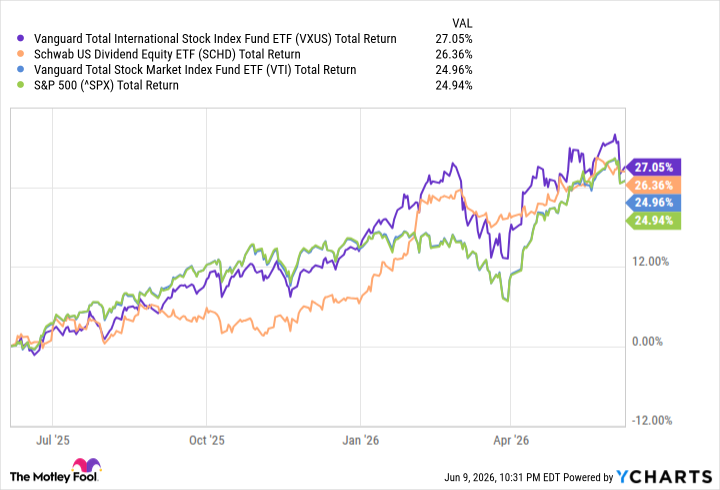
When comparing these ETFs, SMH stands out for its superior past performance, with a five-year average annual return of 36% compared to SOXX's 31%. This outperformance is driven by its heavy allocation to Nvidia and TSMC. However, the decision between SOXX and SOXQ hinges on cost and diversification. SOXX's higher expense ratio (0.34%) contrasts with SOXQ's more economical 0.19%. Over recent years, SOXQ's lower costs have enabled it to modestly outperform SOXX, a trend likely to continue.
For investors prioritizing cost efficiency and a slightly more balanced exposure without sacrificing significant growth potential, the Invesco PHLX Semiconductor ETF (SOXQ) emerges as the preferred choice. While all three ETFs are subject to market fluctuations, their substantial holdings in companies with significant capital expenditure plans and projected revenue growth suggest a promising outlook. It is advisable to consider these ETFs as satellite holdings, managing position sizing carefully.