

Amidst potential regulatory changes surrounding AI due to the 2026 midterm election results, Apple (AAPL) presents a compelling AI investment. Unlike competitors heavily invested in data center infrastructure, Apple is integrating AI directly into its existing devices like the iPhone and Mac.
This strategy, coupled with strong revenue growth from its core products and services, provides Apple with significant financial flexibility. Its lower capital expenditure on infrastructure positions it favorably should new regulations emerge, making it a potentially resilient AI stock for the long term.
Why Apple is the Top AI Stock to Buy and Hold Amidst Regulatory Uncertainty
The 2026 midterm elections have injected a dose of uncertainty into the artificial intelligence (AI) investment landscape. With Democrats now controlling both chambers of Congress, legislative action is anticipated regarding AI safety, electricity consumption, and the burgeoning expansion of data centers across the United States.
Apple's Distinctive AI Strategy
While many leading AI companies, including Nvidia (NVDA), Microsoft (MSFT), Amazon (AMZN), Alphabet (GOOGL, GOOG), Meta Platforms (META), and Tesla (TSLA), are heavily investing in the infrastructure powering the AI revolution – think semiconductors, cloud computing, and data centers – Apple (AAPL) is charting a different course.
Instead of competing in the data center arms race, Apple is strategically integrating AI capabilities directly into its widely adopted ecosystem of products. This includes embedding generative AI features into the iPhone, Mac, and Siri, while leveraging partners for supplementary computing power. This approach is reflected in its financial disclosures: during fiscal year 2026, Apple's capital expenditures (capex) saw a notable decrease of 29% to approximately $9 billion. Concurrently, research and development (R&D) spending surged by 32% to $45.8 billion, underscoring a sustained commitment to software and AI innovation.
This strategy allows Apple to invest in AI advancements without the massive capital outlay required for physical infrastructure, a potentially advantageous position should Congress enact regulations making data center construction more challenging.
Resilience Amidst Potential AI Regulation
The significant energy and water demands of data centers are drawing increased scrutiny regarding utility costs, environmental impact, and the equitable distribution of development burdens. While President Trump's veto power remains a factor, the mere prospect of stricter regulations introduces a layer of unpredictability for major technology firms.
A slowdown in data center construction could impact demand for companies like Nvidia. For cloud service providers such as Amazon, Microsoft, and Alphabet, new regulations might impede expansion plans and complicate financial forecasting. Apple, however, benefits from a vast global installed base of billions of devices. By integrating AI-powered features into existing products, Apple can encourage device upgrades, reinforce customer loyalty, and potentially grow its services segment, all without the immediate need to build new infrastructure.
Apple's Financial Strength as the Core Investment Thesis
Beyond its unique AI strategy, Apple's robust financial performance forms the bedrock of its investment appeal. In its fiscal fourth quarter (ending Sept. 26), Apple reported $114.5 billion in revenue, marking a 12% year-over-year increase. iPhone revenue grew 17% to $57.6 billion, and services revenue reached $31.6 billion. This financial health demonstrates that Apple is not reliant on AI to create entirely new revenue streams overnight.
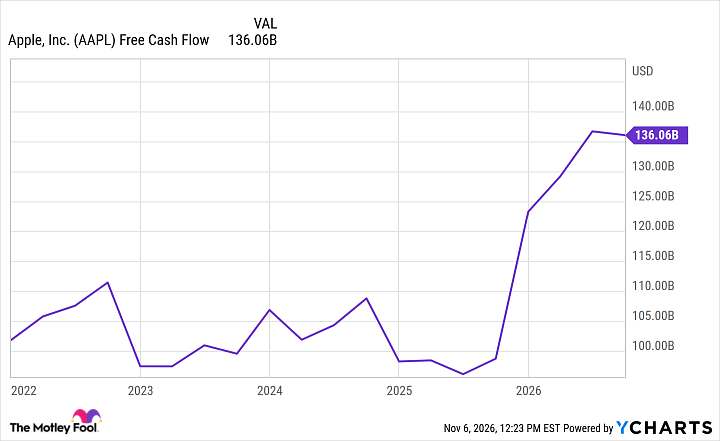
The company's ability to generate substantial revenue from its existing product lines and services grants management the financial flexibility to invest in emerging technologies without jeopardizing its core operations. Furthermore, Apple's comparatively modest capital expenditure allows it to allocate more cash towards dividends, share repurchases, and future innovation.
In conclusion, while the next two years may bring regulatory shifts in the AI landscape, Apple's position is uniquely advantageous. The company can capitalize on AI's potential without needing to dominate the infrastructure race. Its focus on making AI useful and seamlessly integrated into its products ensures continued consumer engagement and product upgrades. For investors seeking a resilient AI stock in the current political climate, Apple stands out as a compelling buy-and-hold opportunity.