





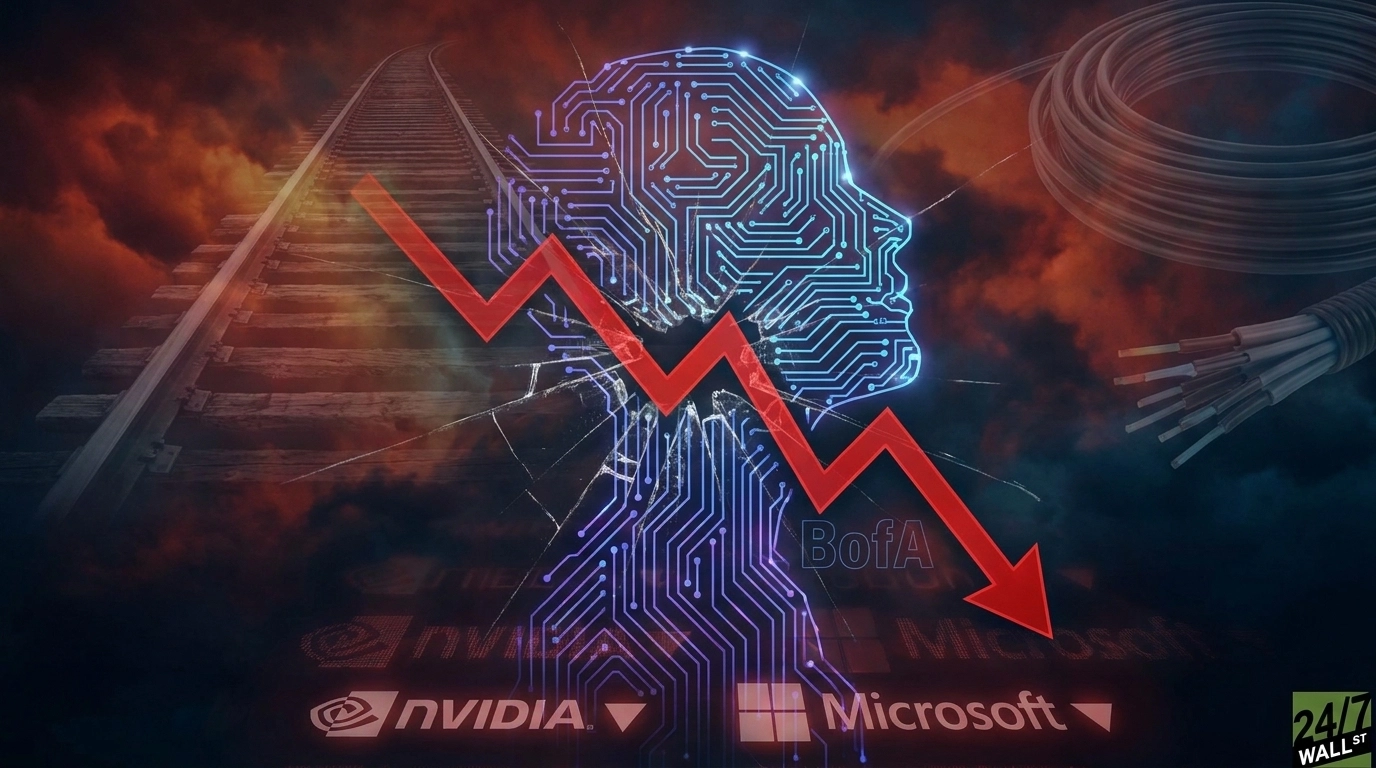
Bank of America strategist Sebastian Raedler warns that investors in artificial intelligence could face losses, even if the technology proves transformative, drawing parallels to historical capital cycles like the railroad and fiber optics booms.
Raedler highlights a concerning surge in hyperscaler capital expenditure and a significant drop in AI token prices, suggesting monetization failures could undermine investor returns in the current AI mania. This outlook places pressure on major AI players like NVIDIA and Microsoft, despite the continued growth of the AI sector.
While artificial intelligence promises to revolutionize industries and reshape the world, investors pouring capital into the sector could still face significant losses, warns Bank of America. Drawing stark parallels to historical booms like the 19th-century railroad expansion and the 1990s fiber optic network buildout—where the underlying technology succeeded but many investors ultimately lost money—BofA investment strategist Sebastian Raedler suggests AI is tracking a similar, cautionary path.
In a report published on October 16, 2026, Raedler articulated that technological success does not automatically translate into profitable investor returns. He highlighted a dramatic increase in 12-month forward consensus hyperscaler capital expenditure expectations, which surged from $330 billion in early 2025 to a staggering $1 trillion. These figures represent the projected spending of the largest cloud operators over the coming year, indicating a massive influx of investment.
The market reacted sharply to Raedler's warning. The Nasdaq 100 experienced a 2.5% decline, and the Philadelphia semiconductor index registered its eighth consecutive loss, marking its longest losing streak since 2008. Major AI players were affected: NVIDIA (NASDAQ:NVDA) slid 1.43% to $214.13, reducing its market value to $5.17 trillion. Microsoft (NASDAQ:MSFT) also saw a decline, falling 1.93% to $529.05, with its market capitalization dipping below $4 trillion to $3.93 trillion.
Understanding Capital Cycles and Investor Risk
Raedler's analysis centers on the "capital cycle" phenomenon: initial strong profits attract substantial investment, leading to overcapacity. As supply outstrips demand, competitive pressures drive down prices and returns on capital, often culminating in bankruptcies for many of the original builders, even as their infrastructure serves the economy for decades. This pattern was evident in the 1870s railroad boom and the 1990s fiber optic bubble.
The strategist further noted that current hyperscaler capital expenditure expectations represent 3% of US GDP, surpassing the 2.2% seen during the 1870s railroad boom and the 1.1% of the 1990s tech boom, indicating a potentially overheated investment environment.
The Impact of Falling Token Prices
A key factor contributing to this risk, according to Raedler, is the rapid decline in "token" prices. Tokens are the units of text processed by AI models, and providers charge per token. Average token prices have plummeted by approximately 50% since the summer. This situation creates a monetization dilemma: even as AI usage and token volumes soar, revenues can stagnate or fall if price declines outpace volume growth. Data from Ramp, cited in the report, shows business AI spending has slightly receded since August, despite rising token volumes.
Raedler explicitly stated that this "monetization disappointment in the face of intense competition is precisely the failure mode seen in past capital cycles."
The implications are significant for tech giants. Microsoft, which sells AI capacity through its Azure cloud platform, faces pressure from cheaper token pricing. Its fiscal 2026 capital expenditure reached $115.95 billion, while free cash flow fell to $66.99 billion. NVIDIA's fiscal third-quarter revenue guidance of around $108.0 billion is directly tied to the stability of these hyperscaler budgets. Other tech stocks also felt the pinch, with Amazon (NASDAQ:AMZN) closing at $250.00, Alphabet (NASDAQ:GOOGL) Class A dropping 2.47% to $340.59, and Meta Platforms (NASDAQ:META) falling 3.72% to $709.33.
Beyond individual stocks, the broader market showed signs of stress, with Korea’s KOSPI experiencing a 20% drop since early October and the chip index trading 13% below its recent high, continuing to decline further.
Assessing Vulnerability: NVIDIA vs. Microsoft
While AI stocks like NVIDIA, up 15.08% year-to-date (despite a recent 6.61% weekly drop), and Microsoft, gaining 7.9% over the month, have shown resilience, Raedler’s warning targets investor returns rather than predicting an outright crash. However, the bear case disproportionately impacts suppliers who are paid upfront.
NVIDIA, trading at 43 times trailing earnings, is particularly exposed, as its sales are heavily reliant on AI capital expenditure budgets. Any reduction in the projected $1 trillion forward expectation would directly impact its revenue.

In contrast, Microsoft appears better positioned. Trading at 29 times earnings, the company's finance chief indicated that capital expenditure on short-lived chips could be scaled back if demand shifts. Moreover, cheaper tokens can actually lower costs for its own Copilot AI products.

From an investment perspective, Microsoft seems better equipped to navigate a potential slowdown in AI spending than NVIDIA. Investors should closely monitor Microsoft’s upcoming earnings report against its guidance of approximately 45% constant-currency Azure growth. A miss on this target could signal that the pressure from falling token prices is significantly impacting major AI capacity sellers.