




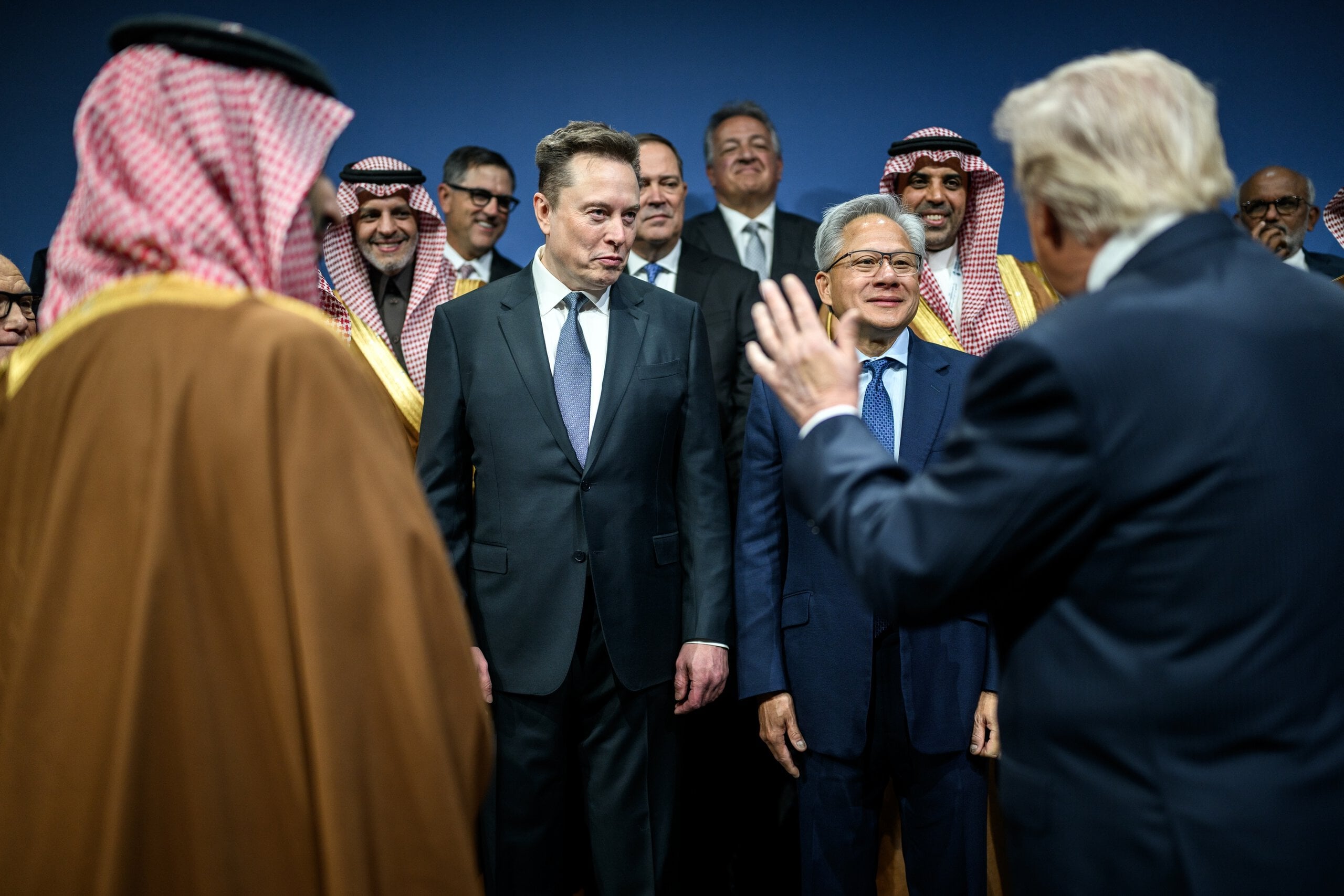
A series of recent developments indicates a monumental collaboration between Elon Musk’s SpaceX and Jensen Huang’s NVIDIA, poised to revolutionize AI infrastructure. SpaceX’s ambitious goal of achieving 10 gigawatts of AI compute capacity by 2027, requiring an estimated $500 billion, appears to be backed by NVIDIA’s new $500 billion Compute Infrastructure Financing Platform and a significant $21 billion investment in SpaceX shares. This strategic partnership aims to accelerate the “largest infrastructure expansion in human history,” diversifying NVIDIA’s customer base and fueling the next era of AI innovation.
Recent seemingly disparate announcements are converging to reveal a groundbreaking development, signaling a strategic alliance with far-reaching implications for the technological landscape.
Over the past fortnight, several key announcements have painted a clearer picture of this emerging synergy. Firstly, Elon Musk's SpaceX committed exclusively to NVIDIA GPUs during an early August conference call, simultaneously setting an ambitious target of 10 gigawatts of AI compute by late 2027. Just days later, NVIDIA unveiled a staggering $500 billion financing initiative through partnerships with major financial institutions like Apollo, BlackRock, Blackstone, Brookfield, Goldman Sachs, and KKR. Finally, NVIDIA's Q2 13F filing on August 14, 2026, disclosed a substantial $21 billion stake in SpaceX, comprising approximately 122.8 million shares.
These collective events illuminate a singular narrative: what NVIDIA CEO Jensen Huang describes as 'the largest infrastructure expansion in human history' is now spearheaded by a definitive and powerful partnership.
Forging the Partnership Set to Define the AI Factory Buildout
NVIDIA (NASDAQ:NVDA) stands as the indispensable supplier of GPUs, networking solutions, and full-stack software foundational to nearly every cutting-edge AI model. The company’s Data Center revenue surged impressively last quarter, reaching $75 billion with a 92% year-over-year increase.
SpaceX (NASDAQ:SPCX) has emerged as the newest colossal buyer in the AI hyperscale arena. Beyond its well-known ventures in rockets and Starlink, the company's AI division — encompassing Grok, Colossus II, and cloud services — generated $2.56 billion in Q2 revenue, a remarkable 247% year-over-year jump. A significant portion of its $18.37 billion single-quarter capital expenditure, specifically $15.83 billion, was channeled into AI infrastructure, figures that are soon projected to appear modest.
Musk articulated on August 4th his vision for SpaceX to scale its computing capacity from the current 1.4 gigawatts to an astounding 10 gigawatts by the close of 2027. This ambitious expansion is estimated to cost approximately $500 billion.
Initially, the market reacted with skepticism to Musk’s bold predictions following earnings, causing SpaceX shares to dip amidst doubts from Wall Street firms regarding the feasibility of securing such massive financing. However, investor sentiment shifted rapidly, with SpaceX shares commencing a significant rally just a few days later (August 7th), pushing the company back above its IPO valuation. This turnaround was largely spurred by research from SemiAnalysis, which affirmed SpaceX’s capability to achieve its 10-gigawatt target by 2027, projecting an Annual Recurring Revenue (ARR) of around $305 billion by the end of that year.
Current Wall Street projections model SpaceX’s revenue at $98 billion for 2027 and $157 billion for 2028, significantly lower than the SemiAnalysis forecast.
NVIDIA Unveils $500 Billion Infrastructure Financing
Adding another crucial piece to the puzzle, NVIDIA announced its pioneering 'Compute Infrastructure Financing Platform' on August 10th. Developed in collaboration with leading Wall Street banks, this platform is designed to mobilize over $500 billion in third-party capital, with NVIDIA committing to backstop up to 25% of project costs.
The final confirmation of this strategic alignment came with NVIDIA’s 13F release on August 14th, disclosing its substantial $21 billion investment in SpaceX.
The progression of events is striking: SpaceX first declared its intent for a monumental data center expansion, exclusively powered by NVIDIA’s chips. This was swiftly followed by NVIDIA’s announcement of a half-trillion-dollar financing initiative and a significant equity investment in SpaceX.
This sequence underscores a logical and mutually beneficial partnership. Jensen Huang has consistently lauded Elon Musk’s drive and unparalleled speed in establishing data centers. Musk, in turn, is embarking on an exceptionally ambitious data center buildout that necessitates vast capital, presenting a financing challenge that NVIDIA is uniquely positioned to help address.
This alliance is a strategic masterstroke. NVIDIA gains a 'backdoor' into fostering a new hyperscaler, leveraging its balance sheet to bolster the AI ecosystem. The $500 billion platform is not merely for SpaceX but also serves as a crucial capital source for other 'neoclouds,' enabling them to compete more effectively with established giants like Amazon, Alphabet, Microsoft, and Meta Platforms.
By nurturing this new funding channel, NVIDIA simultaneously diversifies its customer portfolio. The existing concentration of NVIDIA’s revenue among a limited number of clients has been a persistent factor contributing to its market-average forward P/E, despite its extraordinary growth trajectory.
AI's Future: Woven by the Musk-Huang Partnership
Jensen Huang has previously projected that annual AI infrastructure spending could escalate to $3 trillion to $4 trillion by the decade's end. Many analysts initially misconstrued this as a total over five years, rather than an annual figure, highlighting the scale of his vision.
While current AI infrastructure estimates hover around $800 billion for 2026, with 2027 projections climbing to $1.2 trillion – figures that are already staggering for industry observers – they still represent only a third of Huang’s long-term market outlook. This suggests Huang foresees an AI future that is not only vastly larger but also materializing much sooner than most anticipate.
— a vision, perhaps, shared only by Elon Musk himself.
The confluence of these events leads to a strong conviction: the burgeoning partnership between NVIDIA and SpaceX is poised to become a pivotal catalyst in the next phase of the AI race. What we’ve witnessed over the past two weeks is merely the genesis of this transformative collaboration.